Print quality in the narrow-web label industry often comes down to a single variable: the integrity of the dot. When producing high-resolution graphics, even a slight increase in dot size—known as dot gain—can turn a vibrant, sharp design into a muddy, dark mess. For flexographic and offset printers, controlling this phenomenon is a daily battle. While mechanical factors like plate pressure and anilox selection play a role, the curing process often holds the real secret to crisp imagery.
Proper UV curing, specifically through modern LED technologies, provides the instantaneous “freeze” required to stop ink spread. This guide explores the technical relationship between UV energy and dot gain, offering insights for engineers looking to optimize their narrow-web production lines.
The Mechanics of Dot Gain in High-LPI Printing
Dot gain, or Tonal Value Increase (TVI), occurs when the printed dot ends up larger on the substrate than it was on the plate. In high-resolution printing, typically above 150 LPI (lines per inch), the dots are incredibly small. A 1% or 2% highlight dot has almost no room for error.
There are two primary types of gain: mechanical and optical. Mechanical gain happens during the physical transfer of ink. Optical gain occurs when light scatters within the substrate and the ink layer. However, a third, often overlooked factor is “ink flow” or “slumping.” This happens in the milliseconds between the ink hitting the material and the ink becoming a solid film.
If your curing system doesn’t polymerize the ink fast enough, the liquid ink follows the path of least resistance. It spreads across the fibers or the plastic surface. This results in “halo” effects and loss of detail in the mid-tones.
Why Conventional Drying Falls Short
Traditional water-based or solvent-based inks rely on evaporation. This is a slow process compared to the speed of a modern narrow-web press. As the water leaves the carrier, the solids sit on the surface and settle. This settling time is an open window for dot gain.
UV curing changes the game through photopolymerization. Instead of waiting for a carrier to evaporate, UV-curable inks contain photoinitiators. When exposed to specific wavelengths of ultraviolet light, these chemicals trigger a chain reaction. The liquid monomers and oligomers transform into a solid polymer matrix almost instantly.
For high-resolution labels, this “instant” transition is the only way to ensure that a 5-micron dot stays a 5-micron dot.
The Power of UV Pinning in Flexography
In multi-color flexo printing, “pinning” is a specialized application of UV curing. Instead of a full cure between every station, printers use low-intensity UV lamps to “pin” the ink. This increases the viscosity of the ink just enough to stop it from flowing.
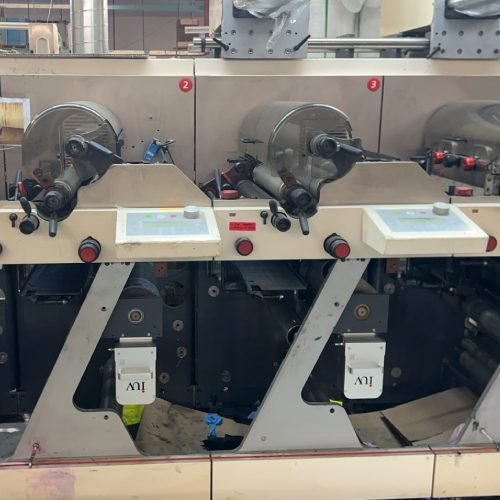
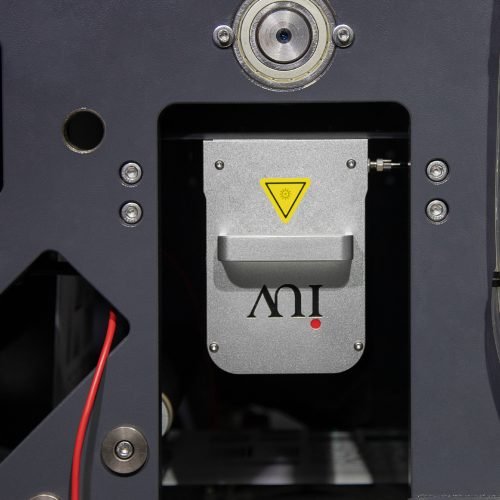
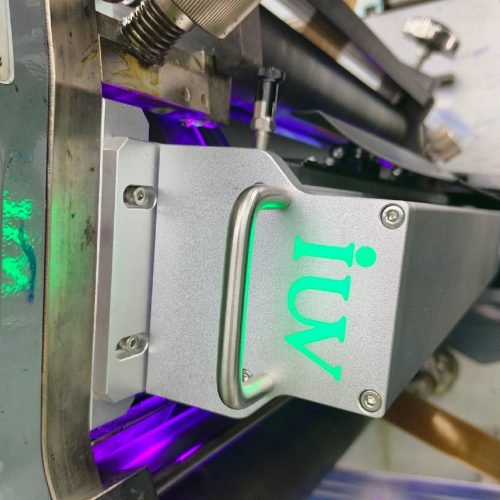
Pinning is particularly useful for narrow-web printers working with non-porous synthetic films. On these surfaces, ink has nowhere to go but out. By using a series of LED UV pinning lamps after each color station, you lock the dot structure in place. This prevents the next printing station from “smashing” the previous wet ink, which is a major source of secondary dot gain in high-res graphics.
LED UV vs. Mercury Vapor: The Sharpness Factor
The industry is rapidly shifting from traditional mercury arc lamps to LED UV systems. From a process engineering perspective, this shift is more than just energy savings. It is about spectral control and heat management.
1. Wavelength Consistency
Mercury lamps emit a broad spectrum of light. While effective, this spectrum includes infrared radiation (heat). Excessive heat causes thin label substrates to stretch and distort. When the material stretches between printing units, registration fails. Poor registration often mimics the appearance of dot gain, as colors overlap incorrectly and blur the edges of the graphics.
LED UV systems emit a very narrow, focused wavelength (typically 385nm or 395nm). There is no infrared output. The substrate remains cool and stable. This stability is vital for maintaining the geometry of high-resolution dots across a long print run.
2. Instantaneous Irradiance
LEDs reach full intensity instantly. More importantly, their output is consistent across the entire width of the web. Mercury lamps degrade over time, leading to “soft” spots in the cure. If one side of the web receives 10% less UV energy, the ink on that side stays liquid longer. This leads to inconsistent dot gain across the web, making it impossible to calibrate the press accurately.
Managing Ink Rheology and Curing Speed
High-resolution graphics require inks with high pigment loads and specific rheological properties. These inks are often “shorter” or more viscous to prevent splashing at high speeds. However, high pigment density can block UV light from reaching the bottom of the ink film.
If the UV intensity is too low, you get a “surface cure” only. The top of the dot is hard, but the base is liquid. Under the pressure of the next print nip or the rewinder, these soft dots collapse. This creates a massive spike in dot gain and can even cause the ink to “pick” off the surface.
To prevent this, engineers must balance press speed with the curing system’s “dose” (measured in $mJ/cm^2$). For high-resolution work, the peak irradiance ($W/cm^2$) is the most critical metric. High peak irradiance ensures that enough photons penetrate the dense pigment layer to solidify the dot from the bottom up.
The Role of Oxygen Inhibition
One of the biggest enemies of a clean UV cure is oxygen. In thin-film label printing, oxygen in the air can inhibit the polymerization of the top layer of ink. This results in a “tacky” surface and allows the edges of the dot to bleed slightly before they fully set.
LED UV systems, because of their high peak intensity, can overcome oxygen inhibition more effectively than low-power lamps. Some advanced narrow-web setups also use nitrogen inertion. By replacing the oxygen at the curing zone with nitrogen, the ink cures instantly and completely. This results in the sharpest possible dot edges, essential for micro-text and high-detail security labels.
Offset Printing and UV Curing
While flexography is dominant in labels, narrow-web UV offset printing is preferred for premium wine and cosmetic labels. Offset uses much thinner ink films than flexo. Because the film is so thin, even a tiny amount of spread represents a huge percentage of dot gain.
In UV offset, the balance between the fountain solution (water) and the ink is critical. If the UV curing is not perfectly synchronized with the press speed, any emulsification in the ink will cause the dots to “blind” or sharpen inconsistently. Precise LED UV curing allows offset printers to run at higher speeds without the fear of “slinging” or dot distortion.
Technical Checklist for Reducing Dot Gain via Curing
To achieve the best results in high-resolution printing, engineers should monitor several key parameters:
- Radiometer Calibration: Regularly measure the output of your UV lamps. Don’t rely on the control panel’s percentage display. Use a high-quality radiometer to check $mJ/cm^2$ and $W/cm^2$.
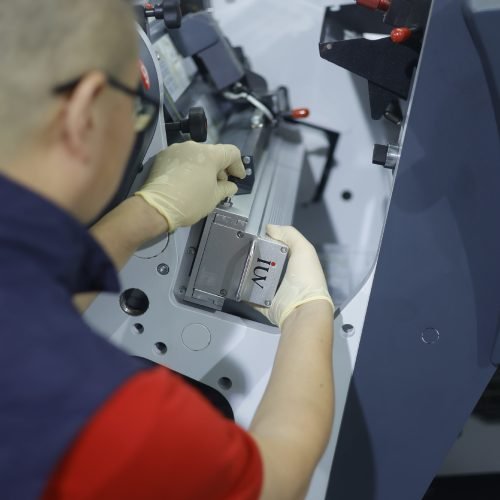
- Lamp Distance: The distance between the UV LED head and the substrate significantly impacts irradiance. A difference of 5mm can be the difference between a sharp dot and a blurred one.
- Substrate Surface Tension: Ensure the material’s dyne level is appropriate for UV ink. If the surface energy is too high, the ink will “wet out” too fast, causing gain before it even reaches the lamp.
- Chilled Rollers: Even with LED, some heat is generated by the exothermic reaction of the ink curing. Use chilled rollers to keep the web temperature consistent, preventing mechanical stretch.
Solving the “Muddy” Mid-Tone Problem
Most printers struggle with dot gain in the 40% to 60% range. This is where dots begin to touch (the “bridge” point). If the curing is insufficient, these bridges expand, causing a sudden jump in density. This is why some labels look “dark” or “heavy.”
By optimizing the UV curing profile, you can shift the bridge point. A faster, more intense cure allows you to print “open” mid-tones that remain stable throughout the run. This is particularly important for skin tones and gradients in high-end food and beverage packaging.
The Future: Smart Curing Systems
The next generation of narrow-web presses integrates the curing system with the press camera. These systems can detect changes in color density in real-time. If the system detects increasing dot gain, it can automatically adjust the UV intensity or signal the operator to check the lamp height.
This level of integration removes the guesswork. It treats UV curing not as a separate “drying” step, but as a fundamental part of the image-forming process.
Final Thoughts for the Process Engineer
Dot gain is often treated as a mechanical issue involving plates and pressure. However, in the world of high-resolution label graphics, the UV curing system is the final arbiter of quality. By moving to LED UV, controlling heat, and ensuring deep photon penetration, printers can produce graphics that were once thought impossible for flexo or offset.
Control the cure, and you control the dot. When the dot is controlled, the graphics speak for themselves. High-resolution printing isn’t just about the plates you buy; it’s about how you freeze the ink in the moments that matter most.