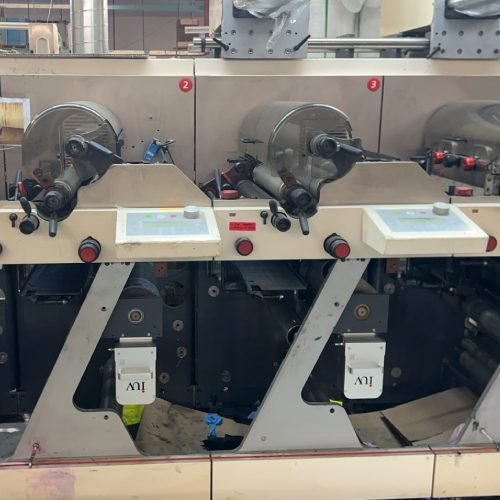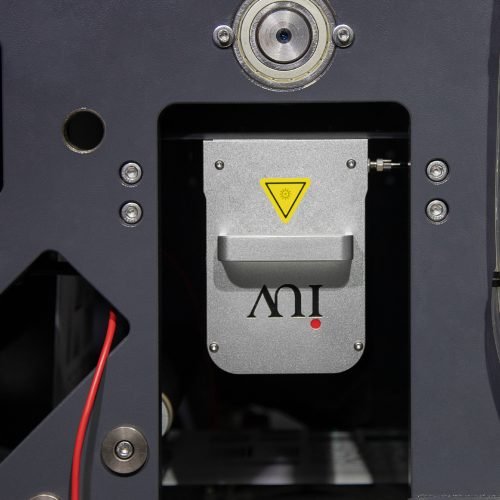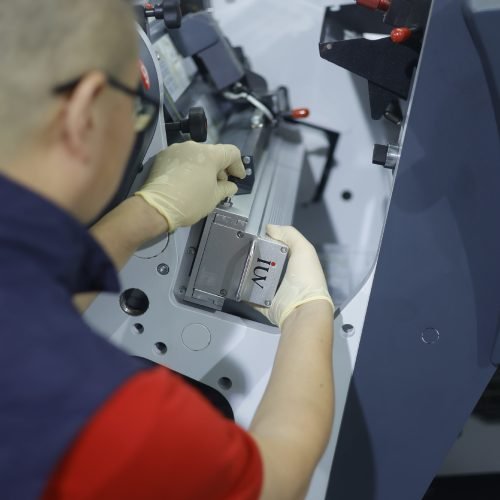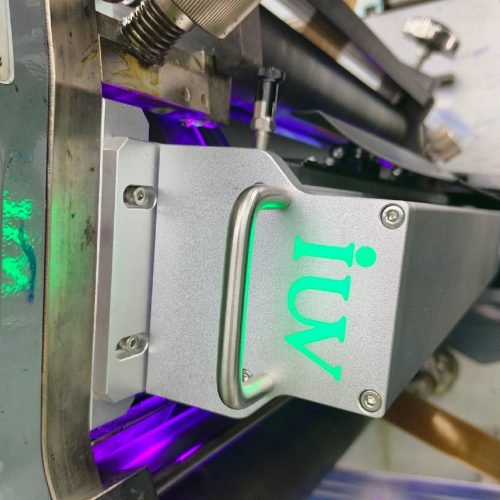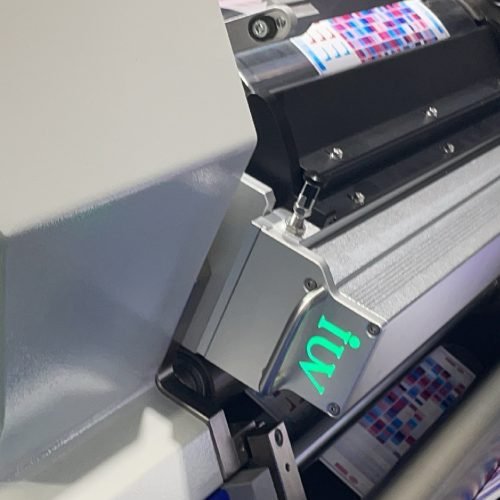
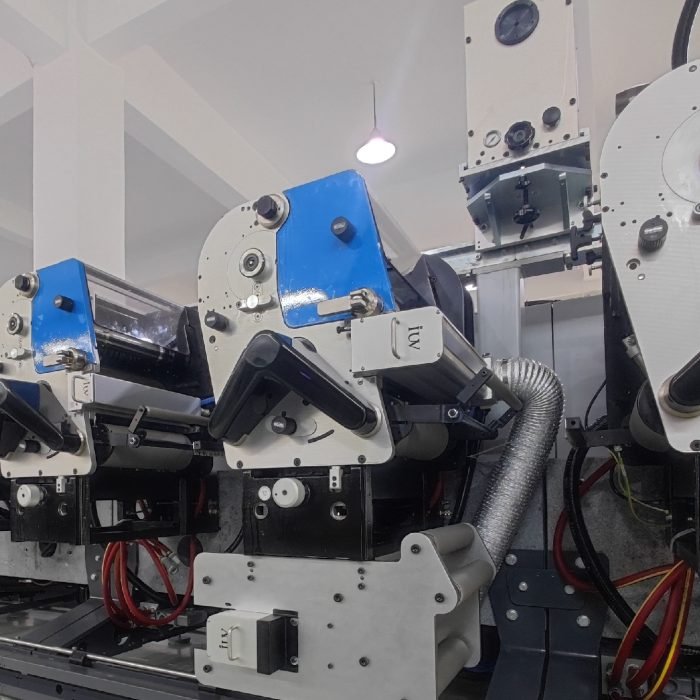
UV curing changes how ink sticks to a substrate. It changes the ink’s chemistry and how the substrate surface reacts. For label printing, flexo, gravure, and narrow-web work, this is critical. LED curing adds further control and efficiency. If you dial cure dose, surface energy, and ink chemistry correctly, adhesion improves and lamination becomes more reliable.
UV Curing Fundamentals for Label and Packaging Printing
UV inks use photoinitiators to start rapid polymerization when exposed to UV light. The cured film becomes a crosslinked network. The cure depth depends on ink film thickness, resin chemistry, and lamp output. LED curing delivers energy in a narrow band with low heat. It supports high line speeds and sensitive substrates. Conventional UV lamps provide broader spectra but add more heat. Both styles require careful dose management to avoid under cure or over cure.
Key terms to know
- Dose: irradiance times exposure time. It determines how completely the ink cures through its thickness.
- Crosslink density: the amount of chemical bonds forming between polymer chains. Higher density increases hardness and chemical resistance but can reduce adhesion to some substrates.
- Oxygen inhibition: at the surface, oxygen can slow or blunt cure, leaving a tacky layer if the dose is too low.
Substrate Surface Energy and Pretreatment
Ink adhesion starts with the substrate. Surface energy drives wetting. If the surface energy is too low, ink beads up and does not form a good bond. Pretreatment raises surface energy and improves adhesion.
Common pretreatments
- Corona treatment inflates surface energy and cleans the surface. It is widely used for polyethylene and polypropylene in label stock.
- Plasma treatment offers deeper modification and can improve adhesion on complex surfaces.
- Primers or coating layers provide a compatible interface between the substrate and UV ink.
Dyne levels guide pretreatment
- PET and coated papers usually need higher dyne levels, often in the 42–52 dynes range for reliable wetting.
- Polyolefins like PE and PP commonly require corona or plasma up to about 38–42 dynes, sometimes higher for demanding inks.
- Paper substrates vary with coating and porosity. Higher porosity can absorb ink and reduce surface tension effects.
Ink Chemistry and Crosslinking
Ink adhesion depends on both wetting and interfacial bonding. UV ink systems blend monomers, oligomers, crosslinkers, pigments, and photoinitiators.
Key factors
- Resin system: Urethane acrylates, polyester acrylates, and polyether acrylates each bring different interfacial behavior with substrates.
- Crosslink density: More crosslinking gives chemical resistance but can hinder adhesion if the ink cannot interdiffuse with the substrate.
- Pigment and pigment carriers: Pigments influence color strength and the interaction with the substrate. White and opaque inks often require higher film build and cure dose.
- Additives: Surfactants and flow agents improve wetting. Adhesion promoters can enhance bonding to challenging surfaces.
Flexo Printing (Label Printing) and UV Cure
Flexo presses rely on fast ink transfer from an anilox roller to the substrate. The ink must wet and spread properly before curing.
Important considerations
- Ink film thickness: Thicker films need more dose to cure completely. Inadequate cure leaves a tacky surface that harms adhesion.
- Transfer dynamics: Poor ink laydown or high smear risk can compromise the interfacial bond after cure.
- Surface roughness: A rough substrate can provide mechanical interlock, aiding adhesion if the ink cures well at the interface.
- Blocking risk: If the cured surface is too rigid or if cure is uneven, there is a risk of layers sticking to itself during processing or stacking.
Gravure Printing (Rotogravure) with UV-Curable Inks
Gravure uses wells on a cylinder to pick up ink. The ink film can be quite thick in gravure, which affects cure behavior and adhesion.
Key points
- Cell wall filling and cure: Ink must fill the engraved cells and cure through the film thickness. Incomplete cure can leave surface tack and weak adhesion.
- Surface formation: The topmost layer needs sufficient crosslinking without creating a brittle surface. Balance is essential for adhesion to the substrate and for lamination compatibility.
- Substrate compatibility: Gravure often uses flexible substrates with coatings. Pretreatment improves wetting and adhesion on these surfaces.
Narrow-Web Printing Considerations
Narrow-web substrates demand high-speed curing and tight tolerances. Adhesion must be consistent across rolls and web paths.
Practical aspects
- Cure dose vs speed: Higher line speed reduces exposure time. Compensate with higher irradiance or multi-pass curing when needed.
- Consistency: LED arrays offer stable dose and low heat. Mercury lamps may vary with lamp aging; monitor output to keep adhesion consistent.
- Formulation choice: For narrow-web, fast cure inks with low shrinkage help maintain dimensional stability and adhesion during web handling.
LED Curing vs Conventional UV Lamps
LED curing has transformed label and packaging print discipline. It changes how adhesion is controlled.
Advantages of LED
- Lower heat input protects heat-sensitive substrates like thin films and certain papers.
- Precise wavelength targeting allows optimized photoinitiator use and faster cure.
- Instant on/off and longer life lower downtime and maintenance.
- Consistent dose across the substrate reduces local cure variations that can degrade adhesion.
Trade-offs and management
- Dose control: LED systems may require higher irradiance to achieve the same cure depth as some mercury systems. Plan for adequate dose in thick ink films.
- Ink formulation: Not all formulations cure equally well with a given LED wavelength. Verify photoinitiator compatibility and adjust resin chemistry if needed.
- System alignment: Lamp intensity distribution and distance to the print plane matter for uniform adhesion.
Cure Dose, Film Thickness, and Adhesion
Dose is the master parameter linking print speed, ink film, and adhesion outcomes.
Guidelines
- Match dose to film thickness: Thicker films demand more energy to cure fully. Under-cured ink can fail adhesion tests.
- Control tint and opacity: White and bright colors often require higher dose due to light scattering and deeper cure needs.
- Manage balance: Too much dose can over-crosslink, making the film brittle and potentially reducing substrate interfacial bonding.
Measurement and Quality Control
To assure adhesion, use practical tests and in-line monitoring.
Tools and methods
- Surface energy measurements (dyne testing) to confirm substrate readiness before printing.
- Tape test or cross-cut test to assess adhesion after cure.
- Peel or pull-off tests for critical laminates and overlays.
- In-line UV sensors monitor dose consistency across the web.
- Print diagnostics track spot-to-spot cure uniformity and ink wetting behavior.
Common Adhesion Issues and Troubleshooting
- Tackiness after cure: Increase dose, improve oxygen management, or adjust photoinitiator system.
- Poor wetting or crawling: Elevate substrate surface energy with pretreatment; adjust ink surfactants.
- Delamination during lamination: Add interlayers or adhesion promoters; tune substrate prep and corona treatment.
- Blocking of finished labels: Balance surface hardness with enough flexibility; ensure proper cure depth and post-c curing.
Lamination and Overprint Considerations
Lamination can influence adhesion outcomes. If a laminate is applied over UV-cured ink, adhesion between ink and the top layer must be strong.
Tips
- Use compatible laminates and, if possible, test before full production.
- Consider adhesion-promoting primers in complex constructions.
- Ensure the UV ink is fully cured before lamination to avoid re-wetting and adhesive interaction.
Practical Recommendations for Labels and Packaging
- Pre-treat substrates to achieve the right dyne level for the chosen ink system.
- Choose an ink system and photoinitiator that match the substrate and the printing method.
- Optimize cure dose based on film thickness, line speed, and substrate sensitivity.
- Prefer LED curing for heat-sensitive substrates and stable process control, but verify ink compatibility.
- Implement real-time dose monitoring and routine adhesion testing as part of production.
- Run trials for new substrates or inks to establish robust adhesion recipes.
Future Trends and Considerations
- Hybrid inks and multi-layer sessions will benefit from tailored cure strategies to balance adhesion with durability.
- Advances in LED efficiency and spectral control will expand substrate compatibility.
- More precise surface pretreatment will enable stronger bonds on challenging films and coatings.
- Data-driven process control will reduce variance in adhesion across large runs.
Conclusion
UV curing directly shapes ink adhesion in label and packaging printing. The interplay of substrate surface energy, ink chemistry, cure dose, and press dynamics determines how well an ink bonds to a substrate. Flexo, gravure, and narrow-web printers all benefit from thoughtful pretreatment, compatible ink systems, and precise LED or UV lamp control. By aligning cure dose with film thickness, maintaining substrate readiness, and validating adhesion with practical tests, you can achieve durable adhesion and reliable lamination for labels and packaging.