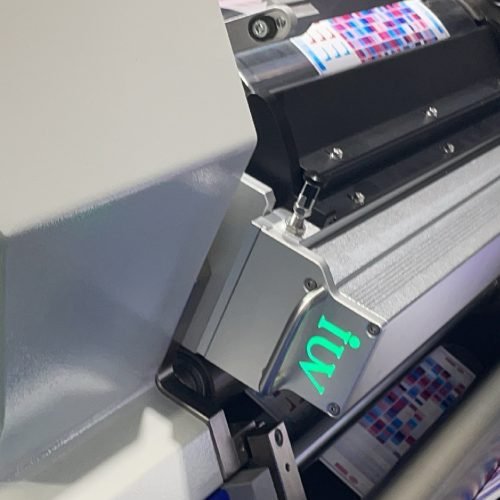
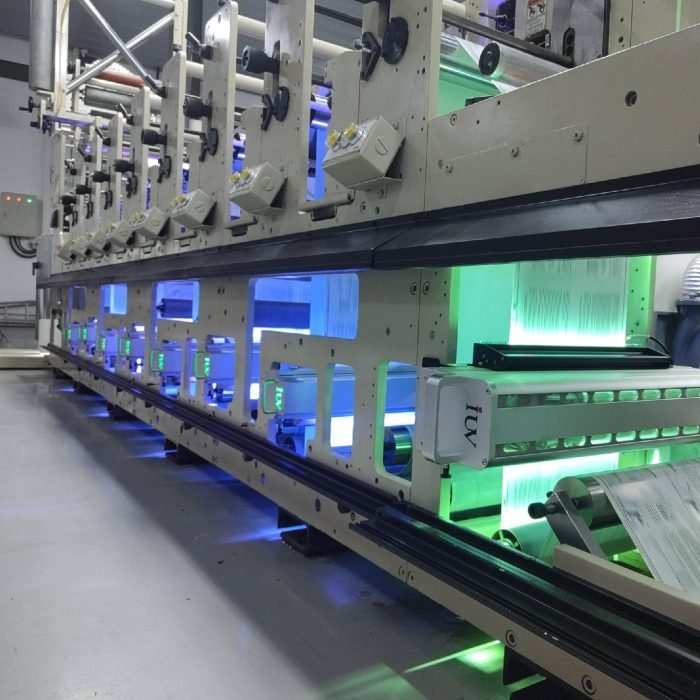
In narrow web label printing, UV LED curing performance depends on far more than lamp power and wavelength selection. One of the most overlooked yet technically decisive parameters is the distance between the LED UV curing unit and the substrate surface. This distance-to-substrate ratio directly affects irradiance efficiency, curing uniformity, and final print durability, especially when printing on non-uniform surfaces.
As label constructions become more complex, printers increasingly work with textured papers, embossed films, linerless stocks, and pre-coated substrates. These surfaces introduce height variations that challenge traditional curing assumptions. Maintaining consistent irradiance across such profiles requires precise control of curing geometry, not simply higher output.
Understanding how distance influences irradiance behavior is essential for flexographic and plate-based narrow web printing, where consistent curing must be achieved at production speed without compromising substrate integrity.
Fundamentals of Irradiance in UV LED Systems
Irradiance describes the intensity of UV energy reaching the substrate surface, usually expressed in milliwatts per square centimeter. In UV LED curing, irradiance decreases rapidly as distance from the source increases. Unlike arc lamps, which emit light omnidirectionally, LED UV systems produce directional output with defined optical angles.
This directionality provides efficiency but also increases sensitivity to distance changes. A small variation in lamp height can lead to a significant drop in surface irradiance. In narrow web printing, where curing windows are already tight, these losses can result in undercured ink, weak adhesion, and reduced resistance to abrasion.
For non-uniform surfaces, the challenge is amplified. Peaks on the substrate may receive sufficient energy, while recessed areas fall below the minimum curing threshold. The result is uneven polymerization across the ink film.
Why Non-Uniform Surfaces Complicate Curing
Non-uniform surfaces are increasingly common in label printing. Textured papers are used for premium branding. Embossed films add tactile value. Coatings and primers may introduce surface roughness. Even adhesive bleed or liner variation can affect surface flatness.
When UV LED curing units are set to a fixed height, they assume a consistent distance across the web. Any surface variation disrupts this assumption. Areas closer to the lamp receive higher irradiance, which may lead to overcuring or surface embrittlement. Areas farther away receive less energy, risking incomplete curing.
In flexographic printing, where ink layers are thin and evenly metered, curing inconsistencies may not be visible immediately. However, downstream processes such as die cutting, rewinding, or label application often reveal weaknesses caused by uneven curing.
Distance-to-Substrate Ratio as a Control Variable
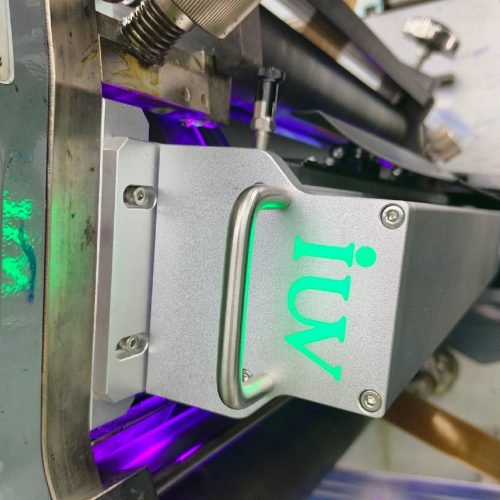
The distance-to-substrate ratio defines how effectively UV energy is transferred from the LED array to the ink film. This ratio must be optimized to balance irradiance intensity, coverage uniformity, and thermal safety.
Reducing distance increases irradiance but narrows the effective curing window. Small surface variations create larger relative differences in exposure. Increasing distance improves tolerance to surface height variation but reduces overall irradiance and curing efficiency.
In narrow web presses, this ratio cannot be adjusted arbitrarily. Mechanical constraints, press design, and safety requirements all limit positioning. The optimal solution lies in understanding how distance interacts with optics, beam angle, and substrate topology.
Optical Design and Beam Geometry in LED UV Units
LED UV curing systems rely on optical elements to shape and focus light output. Lens design determines beam angle, focal point, and irradiance distribution. Narrow beam optics deliver high peak irradiance but are highly sensitive to distance changes. Wide beam optics provide more uniform coverage but lower peak intensity.
For non-uniform surfaces, wider beam profiles often deliver more consistent curing. They reduce the irradiance gradient between surface peaks and valleys. This approach sacrifices some peak intensity but improves overall cure uniformity.
Selecting the correct optical configuration is as important as setting lamp height. In many narrow web applications, optimizing optics allows the system to tolerate greater distance variation without compromising cure quality.
Impact on UV Dose and Cure Depth
Distance affects not only irradiance but also delivered UV dose. UV dose represents the total energy absorbed by the ink as it passes through the curing zone. If irradiance drops due to excessive distance, dose may fall below the threshold required for full polymerization.
On non-uniform surfaces, dose variation can occur across microscopic distances. Valleys may receive insufficient dose even if surface peaks are fully cured. This leads to weak interlayer bonding and poor adhesion to the substrate.
In label printing, where inks must withstand mechanical stress, chemical exposure, and temperature changes, incomplete curing in any region compromises overall performance. Optimizing distance ensures that even the least exposed areas receive adequate dose.
Flexographic Printing Considerations on Narrow Web Presses
Flexographic printing relies on consistent ink transfer and controlled film thickness. Any curing variability undermines this precision. When printing on non-uniform substrates, ink thickness may already vary slightly due to surface topology. Distance-related irradiance variation compounds this effect.
Maintaining a stable distance-to-substrate ratio helps normalize curing across these variations. Press operators should treat lamp height as a process parameter rather than a fixed installation setting. Adjustments may be required when changing substrates or label constructions.
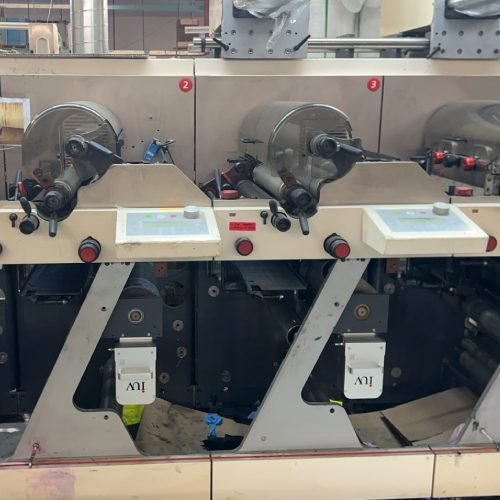
In multi-deck presses, consistency across curing stations is equally important. If distance varies between decks, curing behavior changes from color to color, affecting interlayer adhesion and color stability.
Thermal Effects and Substrate Protection
Reducing distance increases irradiance but also raises the risk of localized heating. Although LED UV systems generate less radiant heat than arc lamps, high irradiance at close proximity can still warm surface peaks more than recessed areas.
On heat-sensitive films or shrink sleeve materials, this uneven heating can cause distortion or internal stress. Increasing distance reduces thermal gradients but must be balanced against irradiance loss.
Optimizing distance therefore supports both curing efficiency and substrate protection. A well-chosen ratio delivers sufficient energy while maintaining a stable thermal profile across the web.
Measurement and Validation in Production Conditions
Optimizing distance-to-substrate ratio requires measurement under real press conditions. Handheld or conveyor-based radiometers should be used to assess irradiance and dose at operating speed. Measurements should account for surface variation rather than assuming a flat reference.
Testing should be conducted on actual substrates used in production. Flat calibration samples do not reveal the effects of texture or embossing. By correlating radiometer data with physical performance tests such as adhesion, scratch resistance, and chemical resistance, printers can validate curing effectiveness.
Once the optimal distance is established, it should be documented and maintained through mechanical checks and preventive maintenance. Even small deviations over time can affect curing consistency.
Engineering Strategies for Non-Uniform Surfaces
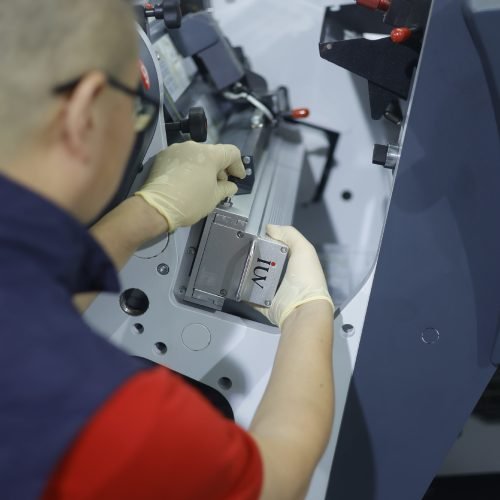
Several engineering strategies help maintain irradiance efficiency on non-uniform surfaces. Adjustable lamp mounts allow fine tuning of distance for specific substrates. Floating or compliant web supports reduce height variation before curing. Optical selection tailored to surface complexity improves energy distribution.
These approaches work best when integrated into a broader curing strategy that considers ink chemistry, wavelength selection, and press speed. Distance optimization is not an isolated adjustment but part of a coordinated system design.
Long-Run Stability and Process Repeatability
In high-volume narrow web printing, repeatability is critical. Once distance-to-substrate ratio is optimized, it supports stable curing over long runs. Consistent irradiance reduces the need for power adjustments and minimizes variation between jobs.
This stability translates into lower waste, fewer customer complaints, and more predictable performance during finishing and application. In competitive label markets, these advantages directly affect profitability.
Aligning Distance Optimization with Modern LED UV Curing
As LED UV technology continues to evolve, curing systems offer greater flexibility in output control and optics. However, fundamental physics still governs energy transfer. Distance remains a primary determinant of irradiance efficiency.
Printers who understand and control this variable gain a significant advantage when working with challenging substrates. Rather than compensating with excessive power, they achieve efficient curing through geometry and design.
Achieving Consistent Curing on Complex Label Surfaces
Optimizing the distance-to-substrate ratio is a practical engineering discipline that delivers measurable benefits in narrow web UV LED curing. It ensures that irradiance reaches all areas of non-uniform surfaces with sufficient intensity and consistency.
By treating distance as a controllable process parameter, label printers can achieve uniform curing, protect sensitive substrates, and maintain high production efficiency. In modern flexographic and narrow web printing, this approach supports both quality and scalability, making it an essential component of advanced UV LED curing practice.