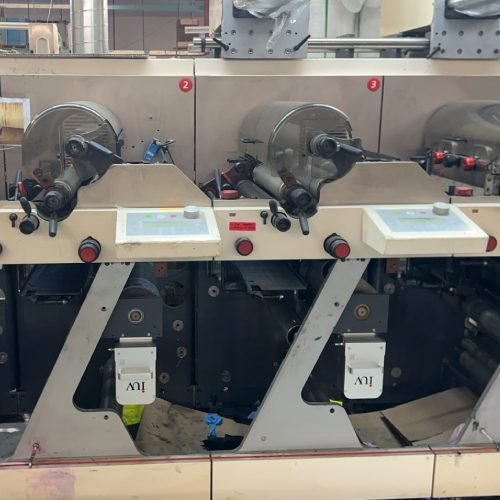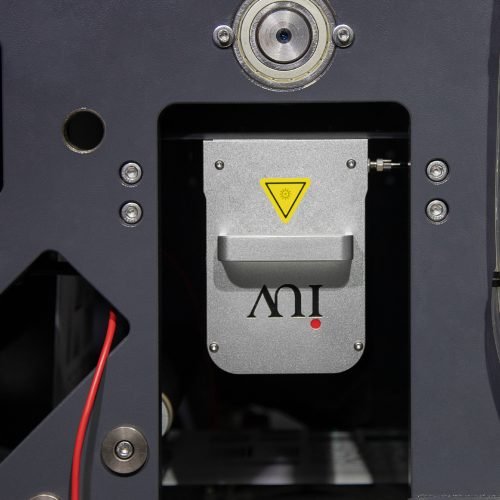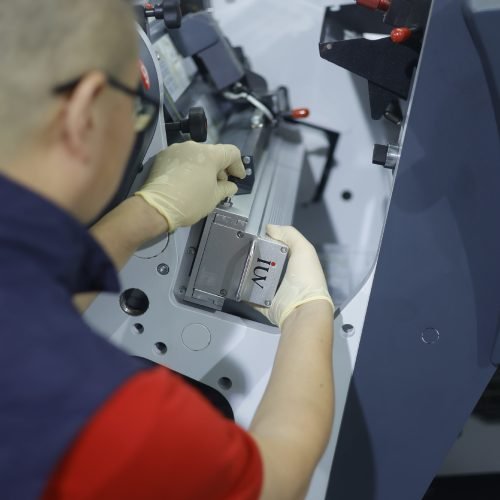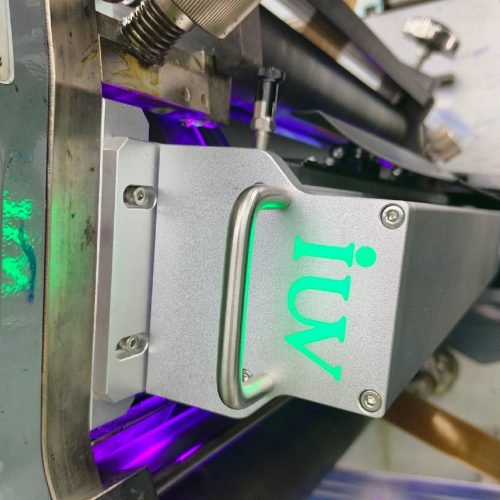
In high-speed narrow web label printing, LED UV curing performance depends on more than peak output settings. Power curves define how lamp output responds to press speed, acceleration, deceleration, and job transitions. Proper calibration of these curves ensures that curing energy remains consistent across the full operating range of the press. Without accurate power curves, even a well-designed LED UV system can deliver unstable curing results, especially during dynamic press operation.
As modern flexographic and offset narrow web presses rely on servo-driven motion and frequent speed changes, static power settings are no longer sufficient. Calibrated power curves allow LED UV lamps to adapt output in real time, maintaining correct energy dose at every speed while protecting substrates and extending diode life.
Understanding Power Curves in LED UV Lamp Control
A power curve defines the relationship between press speed and LED UV output. Rather than operating at a fixed percentage, the lamp increases or decreases power according to predefined speed thresholds. This approach compensates for reduced exposure time at higher speeds and avoids excessive energy delivery at lower speeds.
In narrow web applications, power curves are typically programmed into the LED UV controller or integrated press control system. These curves can be linear or segmented, depending on press behavior and curing requirements. Accurate calibration ensures that energy dose remains stable regardless of speed variations.
Why High-Speed Narrow Web Presses Require Precise Calibration
Narrow web presses often operate at speeds exceeding 150 meters per minute, with frequent job changes and short run lengths. During acceleration and deceleration, exposure time under the LED UV lamp changes rapidly. If output does not track these changes, undercure or overcure can occur within seconds.
Thin films, pressure-sensitive facestocks, and heat-sensitive substrates further increase sensitivity to incorrect power scaling. Precise calibration allows converters to maintain curing performance without compromising substrate integrity or print quality.
Establishing a Stable Mechanical and Electrical Baseline
Before calibrating power curves, the press and LED UV system must be mechanically and electrically stable. Encoder signals should be verified for accuracy and consistency across the full speed range. Any noise, jitter, or scaling errors in encoder feedback will directly affect power curve behavior.
Electrical supply stability is equally important. Voltage fluctuations can alter LED output independently of controller settings. Confirming stable input power ensures that calibration results reflect true system behavior rather than external variation.
Defining the Operating Speed Range
Calibration begins by defining the practical operating speed range of the press. This range should include minimum production speed, typical run speed, and maximum rated speed. Calibration outside this range offers little benefit and may introduce unnecessary complexity.
For narrow web label presses, it is common to define several speed zones rather than a single continuous curve. These zones reflect real production behavior and allow finer control where curing sensitivity is highest.
Measuring Baseline Curing Performance
Before adjusting power curves, baseline curing performance must be measured at several fixed speeds. Radiometric measurements provide insight into irradiance and energy dose delivered at each speed with current settings. Print-based tests, such as surface cure evaluation and rub resistance, confirm practical curing outcomes.
These baseline measurements reveal how much compensation is required as speed increases. They also help identify whether limitations stem from lamp capacity, optical geometry, or process conditions rather than power curve configuration.
Constructing Initial Power Curve Profiles
Initial power curves are typically constructed using incremental output increases as speed rises. At lower speeds, output is limited to prevent overexposure and substrate heating. As speed increases, output ramps upward to maintain energy dose.
The shape of the curve should reflect both curing requirements and lamp efficiency. LED UV lamps often exhibit diminishing returns at very high output levels, where additional power produces less effective curing due to thermal and optical constraints. Recognizing this behavior prevents overdriving the system.
Fine-Tuning Power Steps for Transitional Speeds
Speed transitions are where power curve calibration delivers the most value. During ramp-up and ramp-down, output must respond smoothly to prevent sudden energy spikes or drops. Fine-tuning intermediate power steps reduces visual and mechanical artifacts in printed labels.
In flexographic printing, this stability supports consistent dot gain and ink film formation. In offset and hybrid narrow web presses, it reduces sensitivity to speed-related variations in ink transfer and drying behavior.
Integrating Power Curves with Pinning and Full Cure Zones
Many narrow web presses use multiple LED UV lamps for pinning and final cure. Each lamp may require a distinct power curve based on its function. Pinning lamps often operate at lower energy levels and respond differently to speed changes than full cure lamps.
Coordinating these curves ensures that pinning remains effective without interfering with final cure. Proper integration prevents ink movement during overprinting while maintaining sufficient downstream polymerization.
Validating Calibration Through Print Evaluation
Once power curves are programmed, validation must occur under real production conditions. Running representative jobs across the full speed range reveals how well curing performance tracks press behavior. Print evaluation should include surface hardness, adhesion, gloss uniformity, and die-cut performance.
Consistency across speed changes is the primary indicator of successful calibration. Any recurring defects linked to specific speeds suggest the need for curve adjustment rather than process intervention.
Managing Thermal Effects During Extended Runs
Power curve calibration must account for thermal accumulation during long runs. As LED UV lamps heat up, optical output may drift slightly. Well-calibrated curves anticipate this behavior and maintain curing stability over time.
Monitoring diode junction temperature and coolant performance during calibration provides additional insight. Stable thermal conditions support repeatable power curve behavior and reduce the need for frequent recalibration.
Documenting Calibration Parameters for Repeatability
Documenting calibrated power curves is essential for long-term process control. Press upgrades, controller replacements, or lamp changes may require recalibration, but documented baselines accelerate this process.
Clear documentation also supports multi-press environments, where consistent curing behavior across different machines is required. Standardized calibration procedures improve overall production predictability.
Maintenance Considerations and Periodic Recalibration
Over time, LED output gradually decreases due to natural diode aging. Power curves should be reviewed periodically to compensate for this change. Small adjustments restore curing performance without exceeding safe operating limits.
Routine verification during maintenance cycles ensures that curves remain aligned with actual lamp output. This proactive approach prevents gradual quality degradation that might otherwise go unnoticed.
Benefits for Quality, Efficiency, and System Longevity
Accurately calibrated power curves reduce waste, stabilize print quality, and protect substrates across all operating speeds. They also reduce unnecessary thermal stress on LED diodes, extending system lifespan.
For narrow web label converters operating high-speed presses, power curve calibration transforms LED UV curing from a static setting into a dynamic, process-driven control strategy.
Engineering Perspective on Power Curve Optimization
Calibrating power curves requires a combination of mechanical understanding, electrical insight, and process knowledge. When executed correctly, it aligns LED UV output with real press behavior rather than theoretical speed settings.
In high-speed narrow web printing, this alignment supports higher productivity, broader substrate compatibility, and consistent curing performance. Power curve calibration remains a foundational engineering task in modern LED UV press integration.