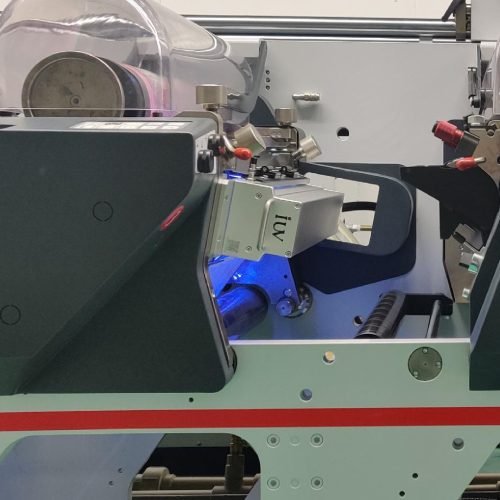
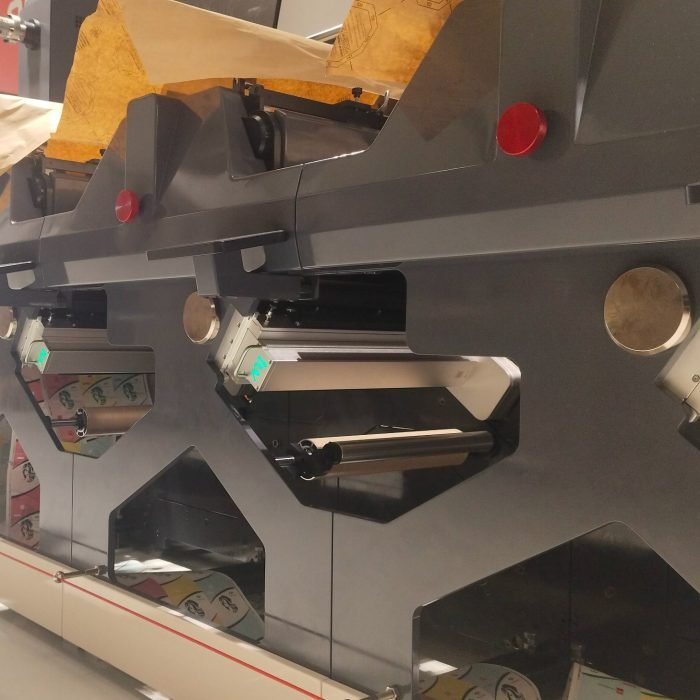
High-opacity white ink serves as the foundation for the majority of premium label and packaging projects. Whether you are running a narrow-web flexo press or a high-speed offset line, the quality of your white base determines the vibrancy of every color printed on top of it. However, curing thick layers of white ink presents unique challenges. This tutorial explores the technical nuances of using LED UV technology to achieve a perfect cure for high-opacity white inks.
The Challenge of White Ink Chemistry
White ink relies heavily on titanium dioxide ($TiO2$) to achieve its brightness and hiding power. $TiO2$ is a pigment designed to scatter and reflect visible light. Unfortunately, it also reflects and absorbs a significant portion of UV radiation. This creates a “shielding effect” where the top layer of the ink film absorbs the UV energy, leaving the bottom layer—the part touching the substrate—liquid and uncured.
Traditional mercury vapor lamps emit a broad spectrum of UV light. While effective for some applications, much of this energy is wasted as heat or blocked by the $TiO_2$ particles. LED UV systems change this dynamic by focusing energy into specific, narrow wavelengths, typically 385nm or 395nm. These longer wavelengths penetrate deeper into the ink film, reaching the substrate interface more effectively than shorter UV-C or UV-B waves.
Why LED UV is Superior for Narrow Web and Flexo
In the narrow web industry, speed and consistency are the primary goals. LED UV curing systems offer several advantages specifically for high-opacity white applications:
- Consistent Output: LED lamps do not degrade over hundreds of hours like mercury bulbs. You get the same irradiance on Monday morning as you do on Friday night.
- Instant On/Off: There is no warm-up time. This reduces the risk of burning the web during press stops.
- Deep Penetration: The 395nm peak of most LED systems is ideal for “seeing through” the pigment layers in thick flexo white applications.
When printing labels on heat-sensitive films like PE or thin PP, LED UV is a game-changer. Since LED units emit very little Infrared (IR) radiation, the substrate remains cool. This prevents shrinking, stretching, or warping of the film, which is vital for maintaining tight registration on multi-color jobs.
Optimizing Anilox Selection for High-Opacity White
In flexo and narrow web printing, the anilox roll dictates the volume of ink delivered to the plate. For high-opacity white, the instinct is often to use the highest volume possible. However, there is a delicate balance between opacity and cure-ability.
If the ink film is too thick, even the most powerful LED lamp cannot penetrate to the bottom. For most LED-curable white inks, an anilox volume between 7.0 and 9.0 $cm^3/m^2$ (approx. 4.5 to 6.0 BCM) provides a good balance. If you need higher opacity, consider printing two thinner layers of white with an intermediate cure, rather than one excessively thick layer. This “double-hit” white technique ensures each layer is fully cross-linked.
Ink Formulation and Photoinitiators
You cannot use standard UV ink with an LED curing system. The ink must be specifically formulated with photoinitiators that react to the 385nm or 395nm peaks. For high-opacity white, the concentration of these photoinitiators is often higher to compensate for the pigment loading.
When switching to LED, work closely with your ink supplier. The viscosity of LED-curable white ink is often slightly different from traditional UV inks. Maintaining the correct viscosity ensures the ink levels out smoothly on the substrate, reducing “pinholing” and improving the overall density of the white base.
Managing the Offset Printing Process
In offset printing, the ink film is much thinner than in flexo, but the pigment concentration is much higher. LED UV curing in offset allows for faster turnarounds and eliminates the need for spray powders.
For high-opacity white in offset, ink-water balance is the most critical factor. Excessive fountain solution can emulsify the ink, leading to “greying” or “scumming.” More importantly, emulsified water acts as a barrier to UV light. If your white ink is struggling to cure on an offset press, check your conductivity and pH levels first. A clean, stable emulsion ensures the UV energy can reach the photoinitiators without interference.
The Importance of Irradiance and Energy Density
To master LED UV curing, you must understand two metrics: Irradiance and Energy Density (Dose).
- Irradiance ($W/cm^2$): This is the intensity of the light at a specific moment. Think of it as the “brightness” of the lamp. High irradiance is necessary to initiate the chemical reaction in high-opacity white inks.
- Energy Density ($J/cm^2$): This is the total amount of light energy the ink receives over time. It is determined by the press speed and the length of the curing zone.
For high-speed narrow web applications, you need high irradiance to start the cure and enough energy density to finish it. If the press is running at 150 meters per minute, the “dwell time” under the lamp is very short. Ensure your LED system is rated for the speeds you intend to run. If the white ink is tacky after curing, you likely need to either increase the lamp power or slow down the press to increase the total energy dose.
Substrate Influence on Curing
The surface of the substrate plays a role in how white ink cures. Non-porous materials like synthetic films reflect some UV light back through the ink layer, which can actually assist in the curing process. Conversely, porous papers can absorb the liquid components of the ink (the monomers), leaving the pigment and photoinitiators “marooned” on the surface.
Always check the dyne level of your substrate. For high-opacity white to bond correctly, the substrate should have a surface tension at least 10 dynes higher than the ink’s surface tension. Poor adhesion is often mistaken for poor curing. Perform a tape test immediately after curing and again 24 hours later to ensure the bond is stable.
Troubleshooting Common Curing Issues
If you encounter issues with your high-opacity white ink, follow this systematic checklist:
1. Check for Surface Tack
If the surface is sticky but the ink doesn’t come off on your finger, the “top cure” is failing. This is often caused by oxygen inhibition. LED systems are more prone to this than mercury systems because they lack shorter wavelengths. Ensure your ink is formulated with “oxygen scavengers” or increase the lamp intensity.
2. Check for Adhesion Failure
If the entire ink film peels away from the substrate, the “through-cure” is the problem. The UV light is not reaching the bottom. Lower your anilox volume or reduce the press speed. Alternatively, check if the LED lamp glass is dirty. Even a thin layer of ink mist on the LED lens can reduce output by 20% or more.
3. Monitor Heat Build-up
While LED is “cold,” the substrate can still get warm from the exothermic reaction of the ink curing. If you notice the web stretching, check your chilled rollers. Proper temperature control keeps the substrate stable and ensures the ink doesn’t “sink” into the material too deeply before it hits the curing station.
Maintenance of LED UV Systems
One of the biggest mistakes in printing plants is treating LED systems as “maintenance-free.” While they don’t have bulbs to change every 1000 hours, they do require care.
- Cooling Systems: Most high-power LEDs are water-cooled. Check the chiller levels and ensure the coolant is free of algae or deposits. A hot LED will lose efficiency and eventually fail.
- Lens Cleaning: Use only recommended solvents and lint-free cloths to clean the LED output window. Scratches on the lens will scatter the light and reduce the irradiance hitting the ink.
- Calibration: Use a calibrated UV radiometer specifically designed for LED (measuring 385/395nm) to check the output regularly. Do not use a radiometer designed for mercury lamps, as it will give inaccurate readings.
Future-Proofing Your Production
Transitioning to LED UV for high-opacity white inks is a strategic move for any label or narrow-web printer. It reduces energy consumption, eliminates ozone emissions, and provides a more stable production environment.
The secret to success lies in the synergy between the ink chemistry, the lamp output, and the mechanical settings of the press. By understanding how $TiO_2$ interacts with the 395nm wavelength, you can push your press speeds higher while maintaining the deep, opaque whites that customers demand.
Focus on the physics of the cure. Measure your energy output. Partner with ink manufacturers who prioritize LED development. When these elements align, high-opacity white ink stops being a bottleneck and starts being a competitive advantage for your printing business.