Ink cracking remains one of the most persistent quality issues in narrow-web label printing. Whether you are running a high-speed flexo press or a precision offset line, the frustration of seeing a beautiful design fracture during die-cutting or folding is universal. This physical failure often stems from a misunderstanding of the UV curing process. When the polymerization of the ink film goes wrong, the result is either a brittle, over-cured surface or an under-cured, tacky layer that lacks structural integrity.
To eliminate cracking, production managers and press operators must look beyond the surface. Understanding the interaction between UV chemistry, LED curing hardware, and substrate characteristics is the only way to ensure a flexible, durable finish.
The Chemistry of UV Polymerization and Brittle Films
UV-curable inks consist of photoinitiators, monomers, and oligomers. When exposed to specific wavelengths of ultraviolet light, the photoinitiators release free radicals. These radicals trigger a chain reaction, causing monomers and oligomers to link together into a solid polymer matrix. This happens in milliseconds.
Cracking usually occurs when this cross-linking density becomes too high. If the ink film is bombarded with excessive UV energy—often from aging mercury lamps or incorrectly calibrated LED systems—the molecular chains become too rigid. This rigidity leaves no room for the ink to stretch. When the label passes through a die-cutting station or is wrapped around a tight radius, the ink film snaps rather than flexes.
Conversely, under-curing can also lead to issues that look like cracking. If the bottom layer of the ink remains liquid while the top “skins over,” the ink lacks adhesion to the substrate. During mechanical stress, the top layer shears off, creating a cracked appearance.
Flexographic vs. Offset: Ink Film Thickness Matters
The risk of cracking varies significantly between flexo and offset printing due to the volume of ink applied.
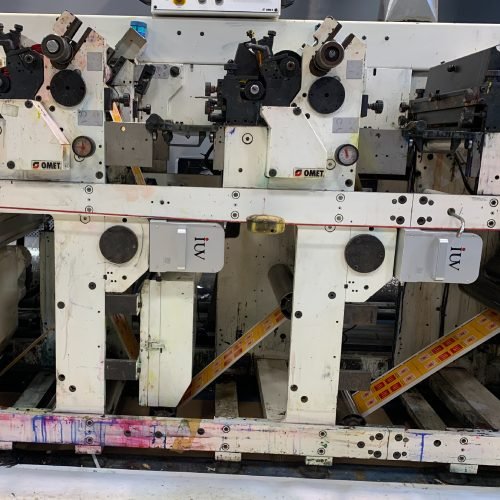
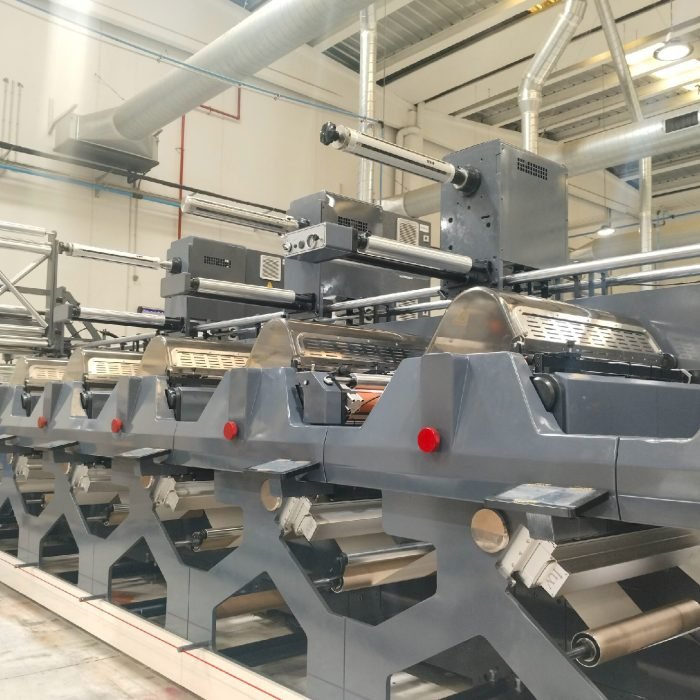
In narrow-web flexo printing, anilox rolls deliver a relatively thick layer of ink compared to offset. Thick ink films are more prone to “through-cure” problems. If the UV light cannot penetrate the entire depth of the ink deposit, the base remains soft. When the label is wound onto a finished roll, the internal pressure causes the brittle top layer to fracture. Operators should use lower-volume anilox rolls when printing on flexible films to keep the ink layer thin and manageable.
Offset printing utilizes much thinner ink films. While this reduces the risk of through-cure issues, offset inks are often more highly pigmented. These pigments can block UV light. In high-speed narrow-web offset applications, the window for proper curing is narrow. Over-compensating with high lamp power to ensure a dry touch often leads to the very brittleness that causes cracking during the finishing stage.
The Shift to LED UV Curing Technology
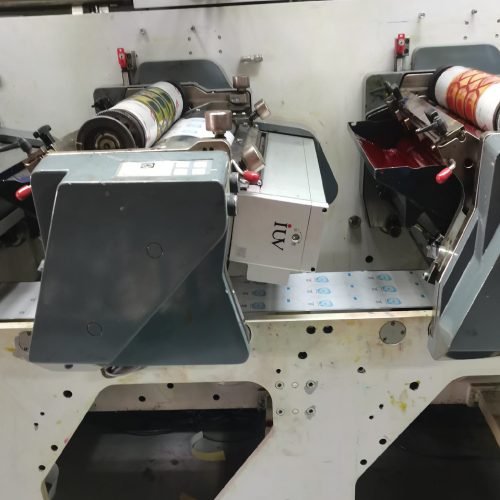
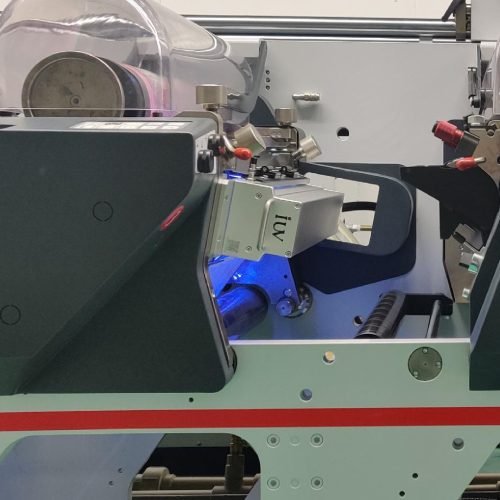
LED UV curing has changed the landscape of label printing. Traditional mercury arc lamps emit a broad spectrum of light, including Infrared (IR). This IR energy creates heat, which can warp thin film substrates like PE or PP. When a substrate warps or shrinks under heat and then cools down, it creates internal stress between the ink and the material. This thermal shock is a leading cause of post-press cracking.
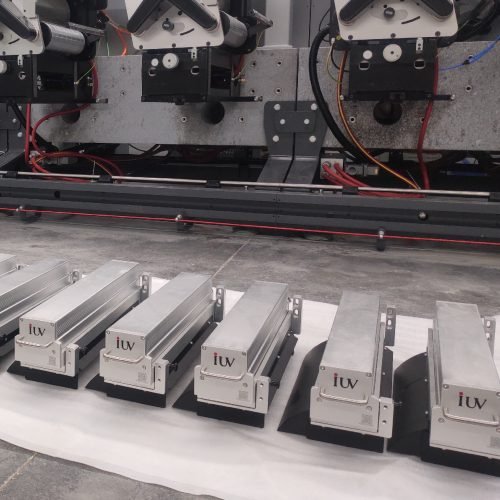
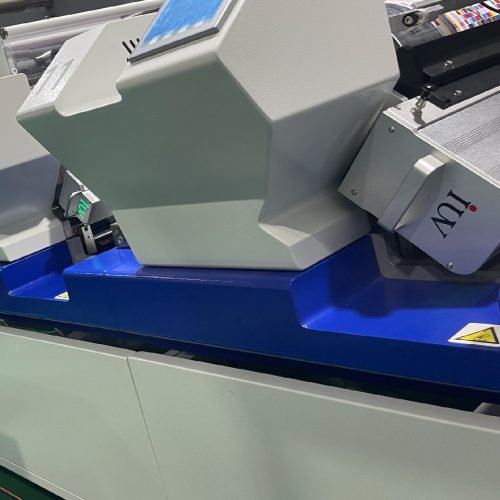
LED systems, typically peaking at 385nm or 395nm, offer a “cold” cure. By eliminating IR radiation, the substrate remains stable. Furthermore, LED provides a consistent output over thousands of hours. Unlike mercury lamps, which degrade and lose their ability to penetrate deep into the ink, LED provides a reliable intensity. This consistency allows for a more controlled polymerization process, ensuring the ink remains flexible enough for die-cutting and subsequent application.
Substrate Surface Tension and Adhesion
Ink cracking is rarely just about the ink; the substrate plays a massive role. If the ink does not bond properly to the material, it will crack and flake off at the slightest bend. This is common in synthetic label stocks.
Before printing, the surface energy of the substrate must be higher than the surface tension of the UV ink. Most narrow-web presses use corona treaters to “open up” the surface of plastic films. If the corona treatment is insufficient, or if the substrate has “aged” and lost its dyne level, the ink sits on top rather than anchoring. A poorly anchored ink film has zero flexibility. Testing dyne levels before a production run is a mandatory step in preventing mechanical failure of the ink.
Impact of Die-Cutting and Finishing
The moment of truth for ink cracking usually occurs at the die-cutting station. The pressure of the die blade against the material creates a localized shockwave. If the ink is over-cured and brittle, the edge of the cut will show “chipping.”
To mitigate this, press operators should monitor the “dosage” (measured in mJ/cm²) rather than just the “intensity” (measured in W/cm²). Dosage represents the total energy the ink receives over time. If you are running the press at a slower speed for a complex job but keep your UV lamps at 100% power, you are significantly over-curing the ink. Modern presses often feature automatic power scaling, where the UV output fluctuates based on the press speed. Calibrating these settings is vital for maintaining ink elasticity.
Narrow-Web Challenges: Tension and Re-Winding
Narrow-web printing involves high-speed transport and tight turns over idler rollers. Each time the web bends, the cured ink film is stretched. If the ink chemistry is not optimized for flexibility—specifically for “shrink sleeve” or “wrap-around” labels—cracking will occur during the run.
Web tension also contributes to the problem. If the tension is too high, the substrate is pre-stretched before the ink is cured. Once the tension is released after the curing station, the substrate “snaps back” to its original length. The cured ink, now a solid plastic film, cannot shrink with the substrate and buckles or cracks. Maintaining the lowest possible stable tension throughout the press is a proven way to reduce these mechanical failures.
Troubleshooting Ink Cracking: A Systematic Approach
When cracking is detected, follow this diagnostic path:
- Check the Ink Film Thickness: Are you using an anilox with too high a volume? Reducing the ink deposit often solves cracking immediately.
- Verify the UV Dosage: Use a radiometer to measure the actual output of your lamps. If the mJ/cm² is significantly higher than the ink manufacturer’s recommendation, dial back the power.
- Assess Substrate Dyne Levels: Ensure the material is properly treated. Ink that doesn’t stick will always crack.
- Examine the Die-Cutting Pressure: Over-pressure on the die-cut cylinder can shatter a perfectly cured ink film. Use the minimum pressure required for a clean cut.
- Review the Ink Chemistry: Some “High-Speed” inks are designed to cure very fast and are inherently more brittle. Switching to a “Flexible” or “Multi-purpose” UV ink series may be necessary for labels that require folding.
The Role of Photoinitiator Balance
In the formulation of UV inks, the balance of photoinitiators determines how the ink reacts to light. Some initiators are designed for “surface cure” (tack-free finish), while others are for “depth cure” (adhesion and through-curing).
In many label applications, cracking occurs because the surface is over-cured to achieve a high-gloss, scratch-resistant finish, while the bottom remains slightly under-cured. This creates a sandwich effect where the brittle top layer has no support. Working with ink suppliers to find a formulation that balances surface hardness with internal flexibility is a key engineering requirement for high-quality label production.
Conclusion
Preventing ink cracking in UV label printing requires a balance between chemical reaction and mechanical stress. By moving away from the “more power is better” mindset and focusing on precise UV dosage, operators can produce labels that are both durable and flexible. Whether utilizing traditional flexo or modern LED-equipped offset presses, the goal remains the same: a controlled polymerization that respects the physical limits of the substrate. Monitoring ink thickness, substrate tension, and curing intensity will transform a problematic production line into a high-yield, high-quality operation.