Narrow web converters face increasing pressure to reduce material costs and improve sustainability. Moving toward ultra-thin films is a logical step. These materials, often ranging from 12 to 30 microns, offer more labels per roll and less waste. However, thin films like PE, PP, and PET present a significant challenge: heat sensitivity. Managing UV curing for these substrates requires a precise balance of chemistry, physics, and mechanical engineering.
Traditional UV systems can easily deform or melt thin webs. To succeed, printers must rethink their approach to heat management, tension control, and curing technology.
The Thermal Challenge of Thin Film Substrates
Ultra-thin films have very low thermal mass. Unlike thick paper or board, they cannot dissipate heat quickly. When exposed to the high temperatures of a standard mercury vapor lamp, the film temperature rises instantly. This leads to several common defects.
First, the web can stretch. Heat softens the plastic, and the tension of the press pulls it out of shape. This destroys color-to-color registration. Second, the film may wrinkle or “cockle.” This happens when the heat causes uneven expansion across the web width. In extreme cases, the film melts or snaps, causing costly downtime.
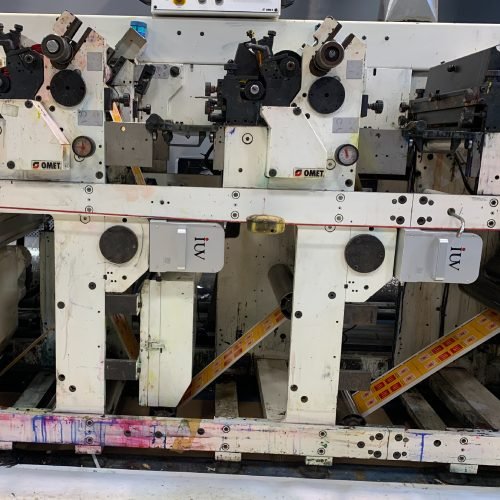
Flexographic and offset presses must be optimized to handle these physics. You cannot simply run thin film on a setup designed for 60-micron stock without making adjustments.
LED UV Curing: The Solution for “Cold” Processing
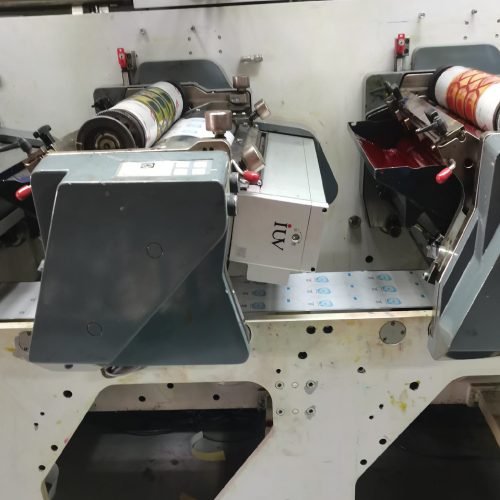
The most significant advancement for thin film printing is LED UV technology. Traditional mercury lamps emit a broad spectrum of light. This includes UVC, UVB, UVA, and a massive amount of infrared (IR) radiation. It is the IR radiation that generates heat.
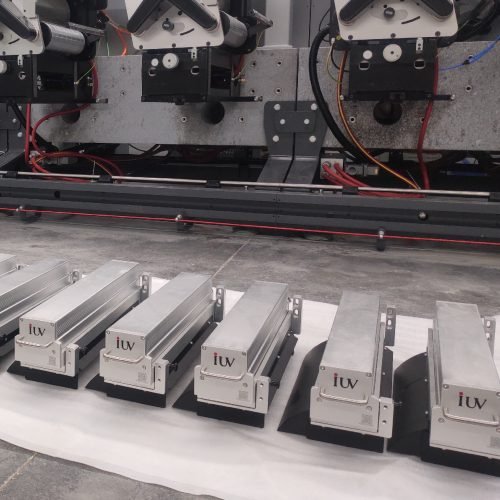
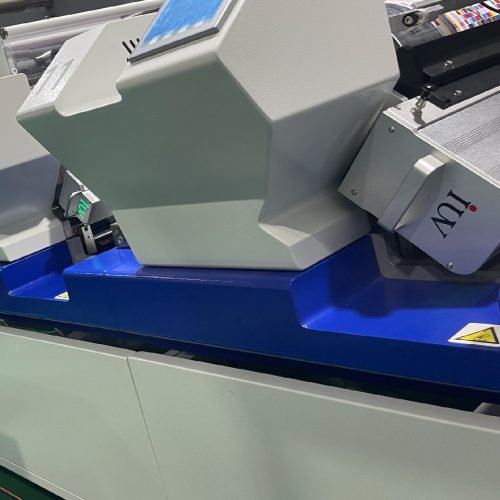
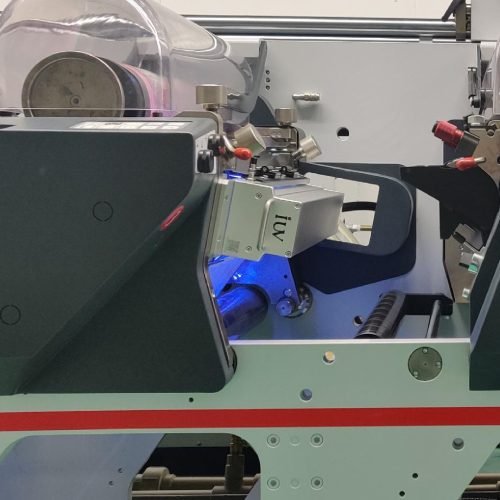
LED UV lamps are different. They emit a narrow band of UVA light, typically at 395nm or 385nm. Crucially, they emit almost no IR radiation toward the substrate. This makes LED UV a “cold” curing process.
For a narrow web printer, switching to LED means you can cure ink on a 15-micron film without the risk of thermal distortion. The substrate remains stable. You maintain registration at higher speeds. Furthermore, LED units do not require warm-up or cool-down cycles. They provide consistent output, which is vital for maintaining a repeatable process on sensitive materials.
Integrating Chilled Rollers and Heat Sinks
Even with LED technology, some heat is generated by the polymerization reaction itself. In traditional mercury systems, heat management is even more critical. This is where chilled rollers (chill drums) become mandatory.
The chilled roller acts as a heat sink. The web wrapped around the roller transfers its thermal energy to the cooled metal surface. For ultra-thin films, the “wrap angle” is vital. You need maximum contact between the film and the chilled roller at the exact point of UV exposure.
Water-cooled systems are generally more efficient than air-cooled ones for thin-gauge materials. If you are using mercury lamps, you might also need “dichroic” reflectors. These specialized mirrors reflect UV light toward the web but allow IR radiation to pass through the back of the lamp head, away from the film.
Mastering Tension Control in Narrow Web Presses
Tension management is the backbone of thin film printing. When you reduce the thickness of a film, you reduce its structural integrity. A standard tension setting for a 50-micron PET film will snap a 12-micron film.
Modern narrow web presses use servo-driven motors to maintain “constant tension.” For ultra-thin films, the press needs sensitive load cells. These sensors detect tiny fluctuations in web pull and adjust the motor speed in real-time.
Lowering the tension is usually necessary, but this creates a new problem: web tracking. If the tension is too low, the web may wander side-to-side. Engineers must find the “sweet spot” where the tension is high enough to guide the web but low enough to prevent stretching during the UV curing stage. Closed-loop tension control is the industry standard for this application.
Ink Chemistry and Photoinitiators
UV curing is a chemical reaction. The UV light hits photoinitiators in the ink, which then trigger the monomers and oligomers to link into a solid polymer. Ultra-thin films require specific ink formulations.
If you use LED UV, you must use inks specifically matched to the LED wavelength. Standard UV inks will not cure properly under a 395nm LED lamp because their photoinitiators are designed for the broad spectrum of mercury lamps.
For thin films, ink adhesion is also a concern. Thin films often have high slip additives or coatings that make bonding difficult. Corona treatment is frequently used before the first printing station to increase the surface energy of the film. This ensures the UV ink “wets out” and grips the surface properly before it reaches the curing unit.
Balancing Dose vs. Intensity
Understanding the difference between UV intensity (irradiance) and UV dose (energy density) is vital for process control.
Intensity refers to the “brightness” of the UV light at a given moment. Dose refers to the total amount of UV energy the ink receives as it passes under the lamp. For thin films, you want high intensity to trigger the surface cure quickly, but you must manage the total dose to avoid overheating the substrate.
As press speeds increase, the “dwell time” under the lamp decreases. To maintain a proper cure, you must increase the lamp power. However, with thin films, there is a ceiling. If you run too slow with high power, the film will melt. If you run too fast, the ink will stay tacky (under-cured).
Using a UV radiometer is the only way to measure this accurately. Regularly checking the millijoules (mJ/cm²) hitting the web ensures that your process remains within the “operating window” of the specific thin film you are using.
Mechanical Adjustments for Narrow Web Stability
The mechanical path of the web through the press influences curing success. On a narrow web press, every roller must be perfectly aligned. On thin films, even a slight misalignment causes “tracking wrinkles.”
The distance between the UV lamp and the substrate—known as the focal length—must be precise. For mercury lamps, being out of focus means losing curing power and increasing heat. For LED systems, the lamp is usually positioned very close to the web (typically 5mm to 10mm) to maximize the peak irradiance.
Anti-static bars are another mechanical necessity. High-speed film printing generates massive amounts of static electricity. Static can cause “spidering” of the ink or even small sparks that interfere with the UV system’s electronics. Placing de-ionizing bars before and after the curing stations helps stabilize the web.
The Role of Oxygen Inhibition
One challenge in UV curing, particularly with thin ink layers on films, is oxygen inhibition. Oxygen in the air can interfere with the chemical reaction at the very surface of the ink. This results in a “tacky” finish, even if the bottom of the ink layer is hard.
In flexographic printing, where ink films are very thin, this is a common issue. Some high-end narrow web setups use nitrogen inerting. This process floods the curing zone with nitrogen gas, displacing the oxygen. While this adds cost, it allows for much faster curing speeds and better surface hardness on sensitive films. It also allows the use of lower UV doses, which further protects the thin substrate from heat.
Maintenance Protocols for Consistent Results
Consistency is the enemy of waste. In a UV curing environment, maintenance is often overlooked. For mercury systems, reflectors must be cleaned weekly. Dust or ink mist on the reflectors reduces curing efficiency, forcing the operator to turn up the power and increase heat.
For LED systems, the protective glass lens must be kept pristine. Any contamination will block the UV photons and lead to uncured spots. Because thin films are so unforgiving, a 10% drop in UV output can be the difference between a perfect job and a rejected roll.
Regularly check the cooling water in your chilled rollers. If the internal channels become scaled or clogged, the heat transfer efficiency drops. The roller surface temperature will rise, and your thin film will start to stretch unexpectedly mid-run.
Future-Proofing Your Curing Process
The trend toward thinner substrates is not going away. Brands want to reduce their carbon footprint, and reducing plastic volume is a primary goal. Narrow web printers who master the “cold cure” process today will have a competitive advantage.
Transitioning to LED UV is the most effective way to manage ultra-thin films. It removes the primary variable that causes material failure: infrared heat. When combined with precision tension control, chilled rollers, and the right ink chemistry, printing on 12-micron films becomes as reliable as printing on standard paper.
Focus on data-driven curing. Don’t rely on the operator’s “feel.” Use radiometers to set your standards, use load cells to manage your tension, and use LED technology to keep your web cool. This systematic approach ensures high-quality labels, minimal waste, and the ability to handle the most challenging thin-film materials in the market.