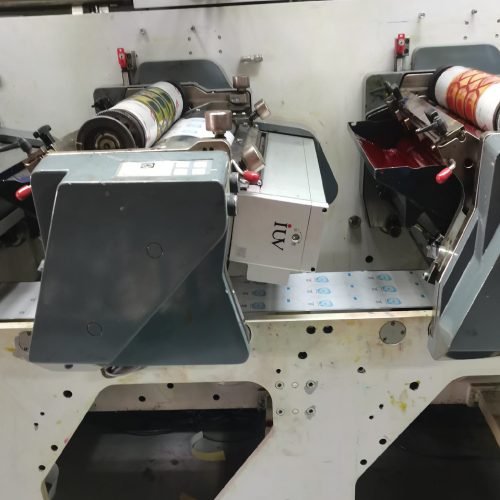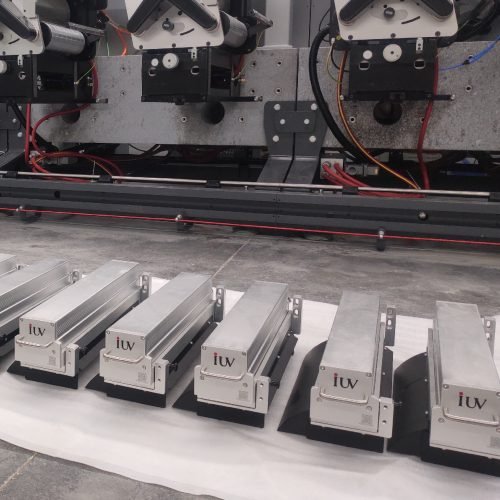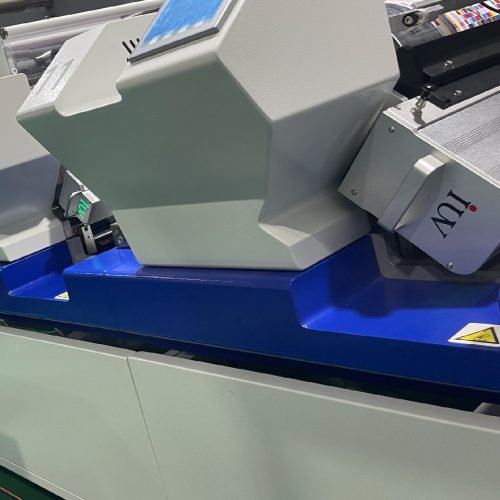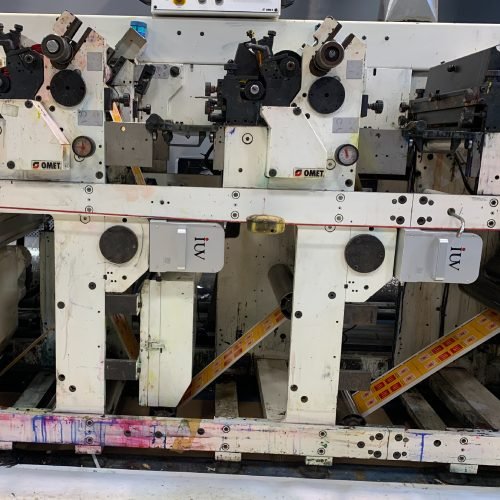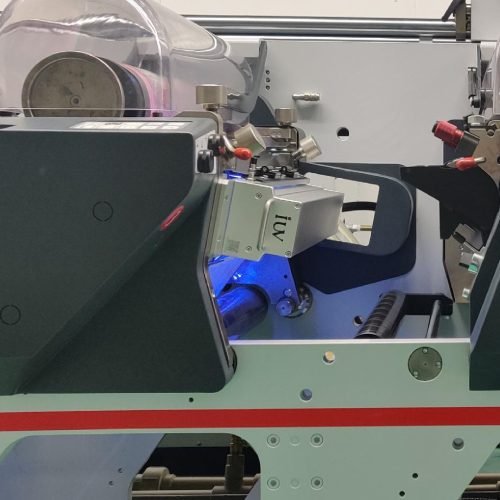
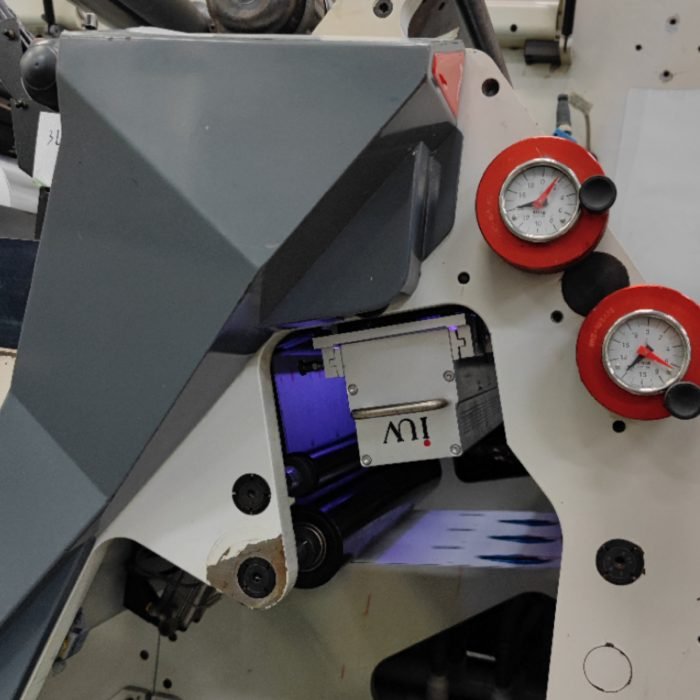
Uniformity in UV curing is the backbone of high-quality narrow web printing. Whether you are running a flexographic press for pressure-sensitive labels or an offset line for thin films, the consistency of the UV dose across the entire web width dictates the success of the run. When exposure varies, you face issues like uncured ink in the center or over-cured, brittle substrates at the edges.
In narrow web environments, press speeds are increasing and substrates are becoming more heat-sensitive. This makes the engineering behind UV exposure more demanding than ever. Achieving a flat profile of irradiance involves a mix of optical physics, mechanical maintenance, and advanced LED integration.
The Physics of Uniformity: Irradiance vs. Dose
To solve uniformity issues, you must distinguish between peak irradiance and total energy density (dose). Peak irradiance is the highest point of intensity under the lamp. Dose is the total accumulated energy the ink receives as it passes through the curing zone.
In narrow web printing, the web moves fast. If your UV lamp has “cold spots” along its length, certain lanes of labels will receive a lower dose. This leads to poor adhesion or “ink pick-off” during die-cutting. You need to ensure that the light output at 50mm from the edge is the same as the output at the center of the mandrel.
Reflectors and Geometry in Traditional Mercury Systems
Traditional mercury arc lamps rely heavily on reflectors to focus UV energy. In narrow web applications, these reflectors are usually elliptical or parabolic. If a reflector is warped or coated with a thin layer of “white dust” (silicone vapor from certain substrates), the light scatters.
Scattered light loses its focus. This creates a non-uniform pattern where the center of the web might be curing perfectly while the edges remain tacky. Engineers should check reflector alignment weekly. Even a 2mm shift in the lamp’s focal point can cause a 20% drop in effective UV dose reaching the web.
Upgrading to “cold mirrors” or dichroic reflectors also helps. These components reflect UV light while absorbing infrared (heat). This keeps the narrow web stable, preventing the film from stretching, which would otherwise alter the ink thickness and curing requirements.
The Shift to LED UV Curing
LED technology has changed the game for narrow web uniformity. Unlike mercury bulbs, which are a single gas-filled tube, LED systems consist of hundreds of individual diodes arranged in a matrix.
The primary advantage here is the “square” output profile. Mercury lamps naturally taper off at the ends of the tube. To compensate, printers often have to buy lamps wider than their web. LEDs provide a consistent intensity from the first diode to the last.
However, LED uniformity depends on the quality of the “binning” process. High-end UV LED curing systems use diodes with nearly identical voltage and output characteristics. If the manufacturer uses cheap, mismatched diodes, you will see “striping” in the cure. As an engineer, you should look for systems that utilize micro-lens arrays. These lenses overlap the light from adjacent diodes, smoothing out any potential gaps in intensity.
Cooling Systems and Their Impact on Output
Heat management is often overlooked in the quest for uniform exposure. The output of both mercury lamps and LEDs fluctuates with temperature. If the cooling air or water is not distributed evenly across the lamphead, the “hot” sections will produce less UV energy.
In narrow web flexo, where lampheads are compact, airflow must be turbulent enough to remove heat but balanced enough to avoid cooling the bulb excessively. If one side of a mercury lamp runs cooler than the other, the mercury vapor distribution shifts. This results in an uneven UV spectral output across the web.
For LED systems, water cooling is generally superior for maintaining uniformity. It ensures every diode in the array stays at a constant junction temperature. This stability means the UV output remains flat across the entire 13-inch or 17-inch width of the press, regardless of how long the job runs.
Integrating Curing with Press Speed
Narrow web printing involves frequent stops and starts. If your UV system does not ramp its power in perfect sync with the press speed, you lose uniformity in the longitudinal direction (along the web).
Modern narrow web presses use “step-less” power control. As the flexo cylinders accelerate, the UV controller increases the lamp wattage or LED current instantly. If there is a lag, the first few hundred feet of labels will be over-cured. This makes the ink brittle and prone to cracking when the label is applied to a tight-radius bottle.
Testing and Validation Protocols
You cannot manage what you do not measure. Ensuring uniform exposure requires regular cross-web testing.
- UV Test Strips: Place five or six color-changing strips across the web width and run them through at production speed. Any color variation between the strips indicates a lens or reflector issue.
- Radiometers: Use a low-profile “puck” radiometer to map the irradiance. Some specialized narrow web radiometers can be attached to the web to provide a real-time profile of the peak intensity across the entire width.
- The “Thumb Twist” and Tape Test: While old-school, these remain the first line of defense in label shops. If the ink clears the tape test on the operator side but fails on the drive side, your lamp alignment is off.
Addressing the “Curse of the Edge”
The edges of a narrow web are prone to “oxygen inhibition,” especially in flexo printing. Oxygen in the air interferes with the radical polymerization of UV inks. Since the edges of the web have more air turbulence, they often require a slightly higher UV dose to achieve the same level of cure as the center.
To combat this, some engineers set their UV lamps to be 10-15% wider than the maximum web width. This “over-scan” ensures that the fall-off zones of the lamp occur outside the printable area. For LED systems, you can sometimes boost the power of the end-modules to compensate for oxygen inhibition at the web margins.
Maintenance for Long-Term Consistency
Uniformity is not a “set and forget” parameter. In an offset or flexo environment, paper dust and ink mist are everywhere. These contaminants settle on the UV quartz plate or the LED windows.
A fingerprint or a smudge of yellow ink on the quartz window will act as a filter. It blocks specific wavelengths, leading to a localized cure failure. Establish a daily cleaning routine using lint-free cloths and high-purity isopropyl alcohol.
Also, monitor the “strike” hours of mercury bulbs. As bulbs age, the electrodes erode and tungsten deposits on the inside of the glass. This usually happens unevenly, causing the center of the bulb to darken faster than the ends. If your radiometer shows a 15% deviation across the web, it is time to replace the lamp, even if it still “looks” bright.
Substrate Influence on Exposure
The material you are printing on also dictates how you manage uniformity. A highly reflective metallic foil will bounce UV light back through the ink layer, essentially doubling the exposure. A porous thermal paper will absorb the photoinitiators, making the ink harder to reach.
In narrow web, where you might switch from a 50-micron PET film to a thick wine-label paper in the same shift, you must adjust the lamp height or focus. Some high-end presses allow for “automatic focal adjustment.” This moves the lamp assembly up or down based on the substrate thickness to ensure the web always sits in the “sweet spot” of the UV intensity curve.
Final Thoughts for the Process Engineer
Ensuring uniform UV exposure in narrow web printing is a balance of optics, thermal management, and rigorous testing. By moving toward LED technology, you eliminate many of the variables associated with bulb aging and reflector degradation. However, the need for precise calibration and clean optics remains.
When your UV profile is flat, your production becomes predictable. You reduce waste, increase your maximum running speed, and ensure that every label—from the left edge to the right—meets the customer’s durability specifications. Focus on the data provided by your radiometers and maintain a strict cleaning schedule to keep your curing system performing at its peak.