The transition from traditional mercury vapor lamps to advanced LED systems marks a significant shift in the narrow web printing industry. For engineers managing multi-color flexographic or offset presses, curing performance directly dictates production speed, substrate versatility, and final product durability. Achieving a perfect cure across multiple ink stations requires a deep understanding of photochemical reactions and mechanical integration.
Technical Foundations of UV Curing in Narrow Web
UV curing is a photochemical process where high-intensity ultraviolet light triggers a chain reaction in specially formulated inks and coatings. In a multi-color narrow web environment, this happens in milliseconds. As the web travels through the press, each color station must reach a specific “state of cure” before the next color is applied.
Traditional mercury lamps emit a broad spectrum of light. This includes UVC, UVB, and UVA wavelengths. While effective, these lamps generate significant infrared heat. In narrow web label printing, heat is often the enemy. It causes thin film substrates to stretch or melt, leading to registration errors.
Modern LED curing systems focus their energy into a narrow band, typically 395nm or 385nm. This monochromatic output eliminates the unnecessary infrared heat. For an engineer, this means tighter control over the web temperature and the ability to run thinner, heat-sensitive materials without distortion.
Inter-deck Curing and Multi-Color Management
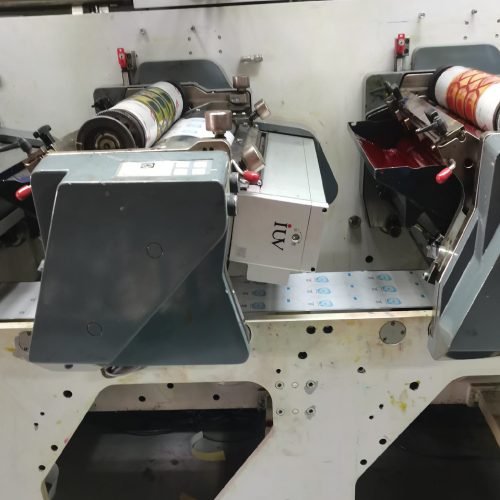
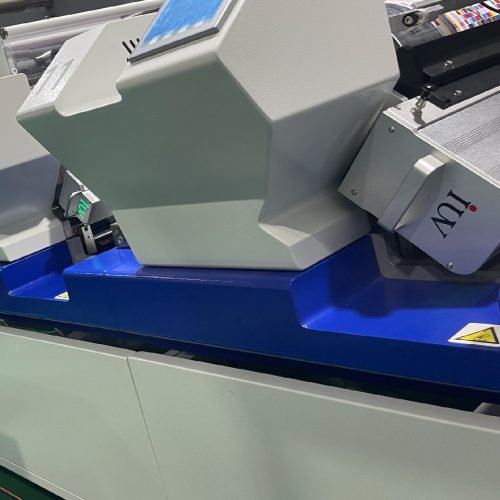
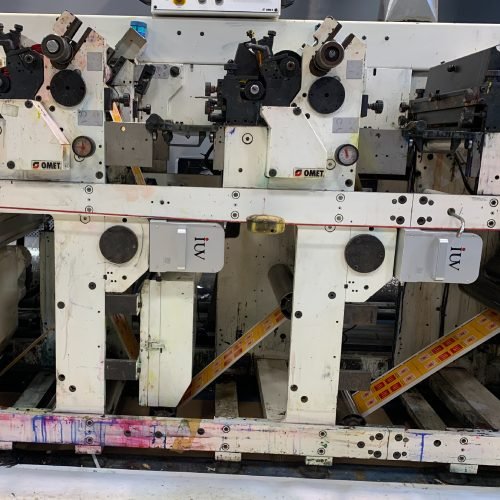
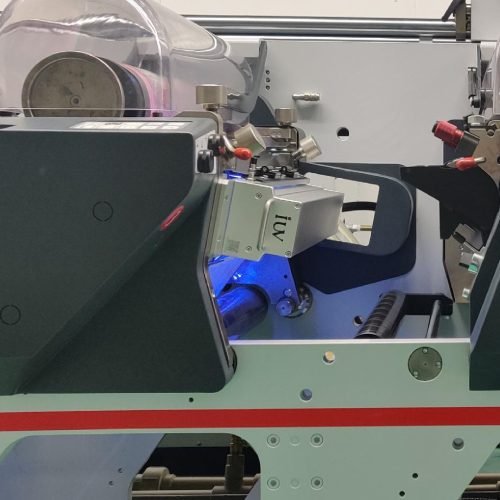
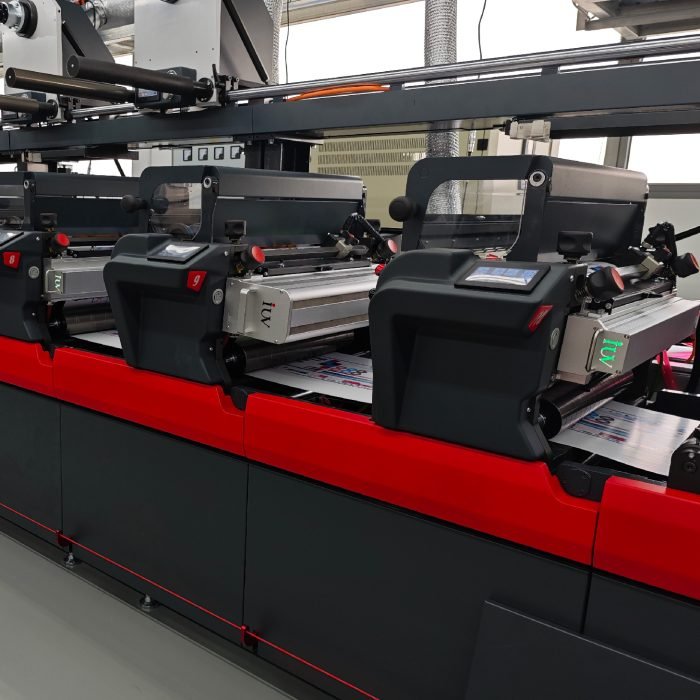
In a 6-color or 8-color narrow web press, the space between printing units is limited. This is where inter-deck curing units are installed. Their primary job is to “set” the ink enough to allow for effective trapping of the subsequent color.
Inadequate inter-deck curing leads to ink pick-up on the following plate. This ruins the color purity and causes downtime for cleaning. From an engineering perspective, the performance of these units is measured by peak irradiance and total energy density.
Peak irradiance, measured in Watts per square centimeter ($W/cm^2$), determines how well the UV light penetrates the ink film. Total energy density, or dose, measured in Joules per square centimeter ($J/cm^2$), ensures the entire molecular structure is fully cross-linked. High-speed multi-color presses require high irradiance to initiate the reaction instantly at the surface.
Flexographic vs. Offset: Curing Requirements
Flexographic and offset printing processes handle UV curing differently due to their respective ink film thicknesses.
Flexo Curing Dynamics
Flexo inks are relatively thick compared to offset. This thickness poses a challenge for UV penetration. If the UV light doesn’t reach the bottom of the ink layer, the ink will skin over but remain wet at the substrate interface. This results in poor adhesion.
Engineers must ensure the spectral output of the LED or mercury lamp matches the absorption profile of the photoinitiators in the flexo ink. Long-wave UVA (found in LED) is particularly good at penetrating thick, opaque white or dark pigmented inks.
Offset Curing Precision
UV offset printing involves much thinner ink films. The challenge here is oxygen inhibition. Oxygen in the air can interfere with the free-radical polymerization at the surface of the ink. This leaves a greasy or tacky finish.
High-performance narrow web offset presses often use nitrogen inertion or high-output LED arrays to overcome this. The goal is to achieve a hard, scratch-resistant surface while maintaining the integrity of the fine dots used in high-resolution labels.
The Role of LED Technology in Modern Performance
LED technology has redefined the efficiency of narrow web presses. Unlike mercury lamps, LEDs provide instant on/off capabilities. This eliminates the need for shutters and warm-up periods. For a production engineer, this translates to higher uptime and lower energy bills.
Furthermore, LEDs maintain a consistent output over their 20,000 hour lifespan. Mercury lamps degrade significantly after just 1,000 hours. This degradation creates a moving target for quality control. With LED, the curing dose remains stable, ensuring that the first meter of a label run looks exactly like the last.
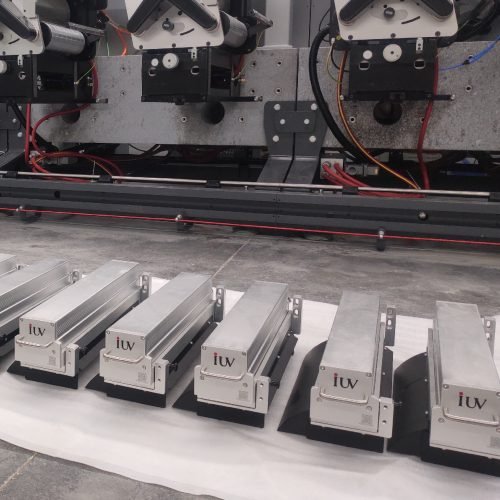
Cooling is another critical engineering factor. LED arrays require either water-cooling or high-velocity air-cooling to maintain their efficiency. A well-designed water-cooling system allows for a more compact lamp head, which is ideal for the tight confines of a multi-color narrow web press.
Substrate Versatility and Thermal Management
Narrow web presses are increasingly used for flexible packaging and shrink sleeves. These substrates are highly sensitive to thermal energy. Standard UV lamps can raise the web temperature to a point where the material loses its structural integrity.
By switching to LED curing, engineers can expand the press’s capabilities. Cold foils, heat-sensitive films, and ultra-thin adhesives become manageable. The “cold” nature of LED curing allows the web to stay flat and stable. This improves registration accuracy across all color stations, which is vital for complex multi-layer label designs.
Measuring and Validating Curing Performance
An engineer’s job doesn’t end with installation. We must validate that the system is performing to spec. This is done using UV radiometers. In a multi-color setup, each station should be checked periodically.
The “Thumb Twist” test is a common shop-floor method for checking cure, but it is subjective. More technical methods include:
- Solvent Rub Tests: Using MEK or alcohol to see how many rubs the cured ink can withstand.
- Tape Tests: Checking for adhesion between the ink and the substrate.
- Spectrophotometry: Ensuring that the curing process hasn’t caused a color shift.
If an engineer notices a drop in performance at station four, they can investigate the specific LED module or the condition of the reflector in a mercury system. This targeted maintenance prevents mass spoilage of expensive label stock.
Efficiency, ROI, and Maintenance
From a financial and operational standpoint, the curing system is a major component of the press’s ROI. Traditional UV systems require frequent bulb replacements and hazardous waste disposal for mercury. They also consume vast amounts of electricity, much of which is wasted as heat.
LED systems reduce energy consumption by up to 50% or 70% in some narrow web applications. Since the lamps only turn on when the web is moving, there is no wasted energy during setup or roll changes.
Maintenance becomes a matter of keeping the protective glass clean and ensuring the cooling system is free of debris. This shift from “reactive” maintenance (fixing burnt-out bulbs) to “preventative” maintenance (cleaning lenses) allows for a much more predictable production schedule.
Ink Chemistry: The Invisible Variable
Curing performance is not just about the hardware; it is about the chemistry. UV inks must be formulated specifically for the light source. LED-curable inks contain photoinitiators that are tuned to the 395nm wavelength.
Using the wrong ink can lead to “ghosting” or incomplete curing, regardless of how powerful the lamps are. Engineers must work closely with ink suppliers to ensure the viscosity, pigment load, and photoinitiator package are optimized for the specific narrow web press speed.
Future Trends in UV Curing for Narrow Web
The industry is moving toward hybrid systems. Some presses now feature a mix of mercury and LED stations. This allows printers to use specialty coatings that may still require UVC light while benefiting from LED for the primary colors.
However, as ink chemistry improves, the move toward full LED sets seems inevitable. The ability to integrate digital sensors into LED arrays allows for real-time monitoring of curing intensity. This data can be logged for quality assurance, providing a digital “birth certificate” for every roll of labels produced.
Final Engineering Summary
Optimizing UV curing performance in multi-color narrow web presses is a balance of physics and chemistry. Whether utilizing the raw power of mercury lamps or the precision of LED, the objective remains the same: total polymerization at maximum press speed.
For the modern engineer, the focus remains on thermal stability, energy efficiency, and consistency. By mastering these variables, a printing facility can guarantee high-quality output on the most challenging substrates, ensuring a competitive edge in the global label and packaging market. Professional management of the curing process is no longer an option—it is the backbone of high-speed narrow web production.