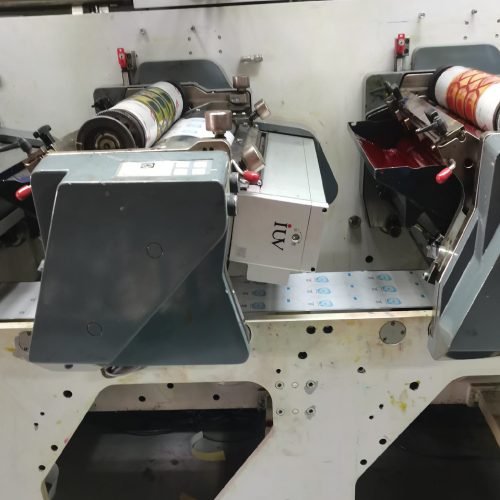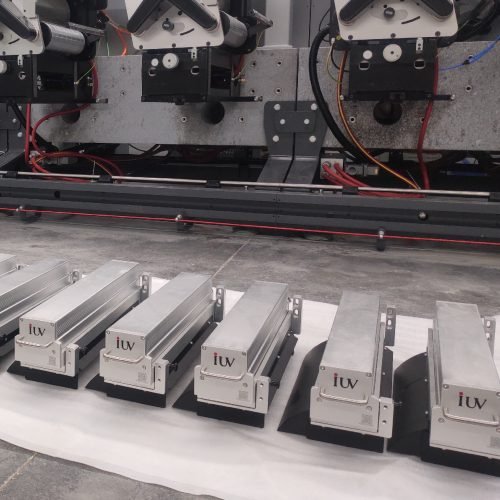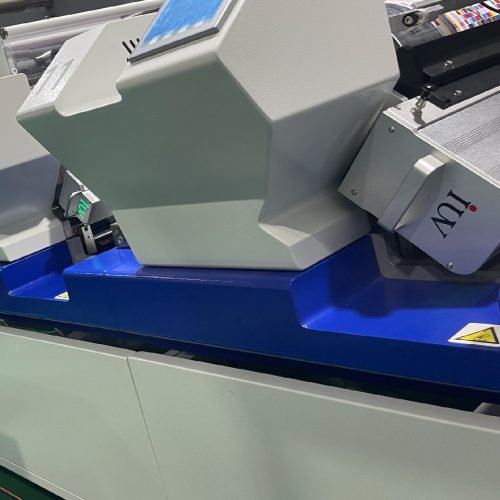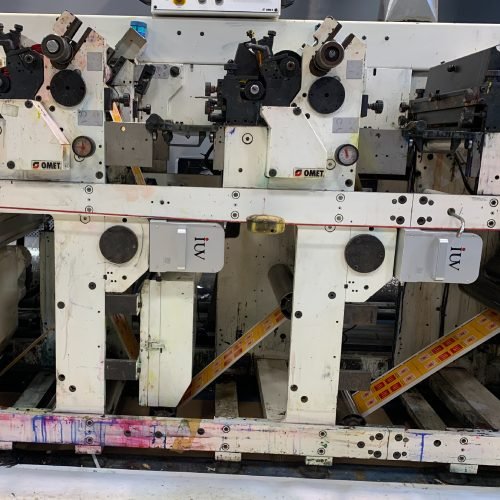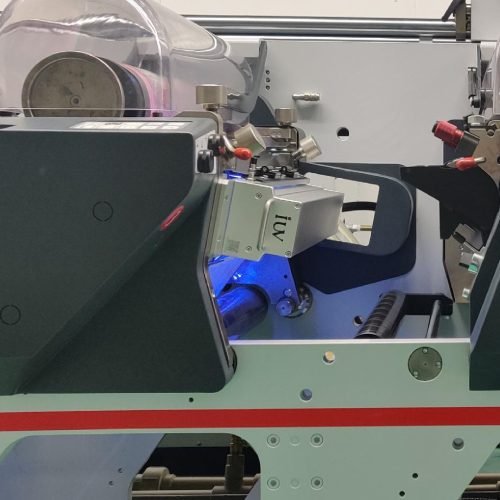
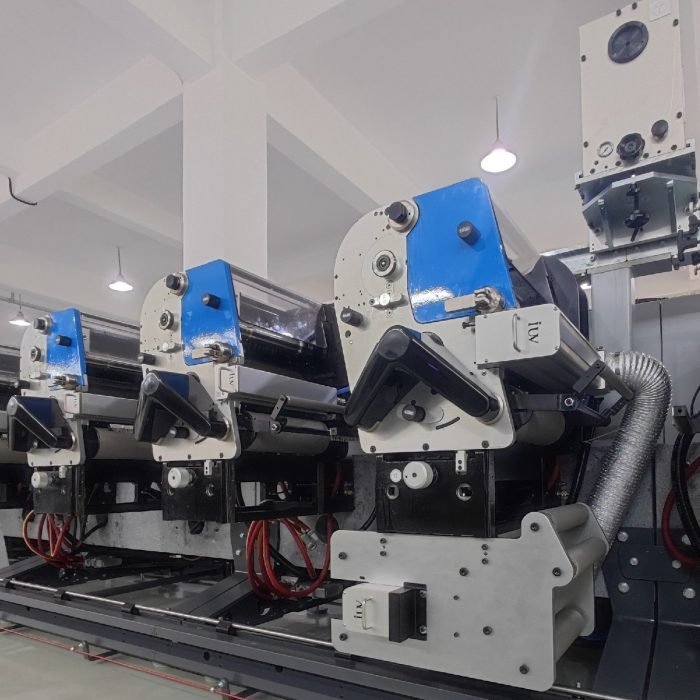
High-speed inline cold foiling and varnish processes place extreme demands on curing technology, especially in narrow web label printing. As brand owners demand higher visual impact, shorter lead times, and improved sustainability, printers must evaluate whether traditional mercury vapor UV systems or modern 395nm LED UV systems provide better performance under real production conditions. This comparison focuses on flexographic and letterpress label printing, with particular attention to cold foil adhesion, varnish curing stability, and inline process efficiency.
Rather than focusing on general UV concepts, this article examines how each curing technology behaves during high-speed, narrow web operations where curing margins are tight and process stability is critical.
Curing Requirements in Inline Cold Foiling and Varnishing
Inline cold foiling relies on a UV-curable adhesive that must reach a precise cure state. The adhesive must be sufficiently cured to anchor the foil layer while retaining enough surface reactivity to ensure clean release from the carrier film. Over-curing reduces foil transfer efficiency, while under-curing causes edge lifting, foil breaks, and inconsistent metallic coverage.
Varnish applications, especially high-gloss and tactile coatings, require uniform surface curing and sufficient depth cure. In narrow web presses, varnish layers are often thicker than ink films, increasing the importance of wavelength penetration and energy distribution.
High press speeds amplify these challenges. At elevated line speeds, curing systems must deliver consistent energy without introducing excessive heat or process variability.
Operating Principles of Mercury Vapor UV Systems
Mercury vapor UV lamps emit a broad spectrum of UV and visible radiation, typically ranging from UV-C through UV-A. This wide spectral output activates a broad range of photoinitiators and promotes good penetration through thicker coatings.
In cold foiling applications, mercury lamps have traditionally been favored due to their forgiving curing window. The scattered light profile allows UV energy to reach adhesive layers from multiple angles, reducing sensitivity to coating thickness variations and surface irregularities.
However, mercury systems generate significant infrared heat. In narrow web printing, this heat can distort thin films, affect adhesive rheology, and limit press speed when running heat-sensitive substrates.
Operating Principles of 395nm LED UV Systems
395nm LED UV systems emit a narrow spectral band optimized for modern LED-compatible inks, adhesives, and varnishes. The output is stable, instantly available, and free from warm-up delays.
In high-speed inline applications, LED UV systems provide consistent irradiance over time. This stability improves repeatability during long runs and frequent job changes. Reduced heat output minimizes substrate deformation, making LED UV especially attractive for filmic label stocks used in premium cold foil designs.
However, the directional nature of LED light creates a narrower curing window. Adhesive and varnish formulations must be specifically engineered for 395nm curing to ensure reliable polymerization at production speeds.
Cold Foil Adhesion Performance Comparison
In mercury vapor systems, cold foil adhesives benefit from deep penetration and wide activation. Foil transfer is generally robust across a range of press speeds and adhesive weights. This tolerance has made mercury lamps a reliable choice for complex foil designs and heavy adhesive layers.
395nm LED UV systems deliver more controlled curing. When paired with LED-optimized adhesives, foil definition is sharper and edge cleanliness improves. The reduced thermal load prevents adhesive flow during curing, which supports fine detail reproduction.
Challenges arise when legacy adhesives are used with LED systems. Incomplete curing or inconsistent foil release may occur if photoinitiator systems are not matched to the 395nm wavelength.
Varnish Curing and Surface Finish
Mercury vapor lamps provide strong surface and depth cure for varnishes due to their broad spectral output. High-gloss finishes are achievable even at elevated coat weights. However, heat buildup can cause surface tension variations, leading to orange peel effects or gloss inconsistency at high speeds.
395nm LED UV systems excel in surface control. Varnish flow remains stable during curing, improving leveling and tactile consistency. For structured or textured varnishes, LED curing reduces thermal collapse of raised features.
Depth curing must be carefully managed. Thick varnish layers require sufficient energy density and appropriate photoinitiator selection to avoid under-cured zones beneath the surface.
Impact on High-Speed Narrow Web Productivity
Mercury vapor systems often require slower acceleration and deceleration due to warm-up and cooling cycles. Lamp aging leads to gradual output decay, requiring frequent monitoring and replacement.
LED UV systems reach full output instantly and maintain stable irradiance throughout their service life. This allows faster job changeovers and consistent curing at high speeds. In narrow web environments with frequent SKU changes, this operational advantage becomes significant.
Energy efficiency also plays a role. LED systems consume less power and eliminate ozone generation, reducing ventilation requirements and improving pressroom conditions.
Process Control and Repeatability
Mercury lamps exhibit output variation over time due to electrode wear and reflector contamination. This variability can affect cold foil transfer consistency and varnish cure margins, especially during long production runs.
395nm LED UV systems offer precise control over irradiance. Output can be adjusted digitally, enabling fine tuning for different adhesive and varnish combinations. This level of control supports tighter process windows and reduces material waste.
However, LED curing requires stricter process discipline. Press speed, coating weight, and lamp distance must be carefully controlled to maintain curing stability.
Substrate Compatibility and Heat Sensitivity
Heat-sensitive substrates are increasingly common in label printing. Thin PE, PP, and PET films are prone to shrinkage and distortion under mercury lamp exposure.
LED UV systems significantly reduce thermal stress, enabling higher speeds and improved registration on these materials. For inline cold foiling on films, reduced heat improves foil flatness and long-term adhesion.
Paper substrates are generally compatible with both technologies, though LED systems offer improved dimensional stability during long runs.
Total Cost of Ownership Considerations
Mercury vapor systems have lower initial capital costs but incur ongoing expenses related to lamp replacement, energy consumption, and maintenance. Regulatory pressure on mercury usage is also increasing in many regions.
LED UV systems require higher upfront investment but offer long service life, reduced energy costs, and minimal maintenance. Over time, total cost of ownership often favors LED technology, particularly in high-utilization narrow web presses.
Choosing the Right Technology for Your Application
The choice between mercury vapor and 395nm LED UV systems depends on application requirements rather than technology trends. Mercury systems remain effective for legacy ink and adhesive systems and for applications requiring broad curing tolerance.
395nm LED UV systems are ideal for printers focused on high-speed inline cold foiling, premium varnishes, and heat-sensitive substrates. When paired with LED-optimized materials and proper process control, they deliver superior consistency and efficiency.
Conclusion
Traditional mercury vapor and 395nm LED UV systems each offer distinct advantages for high-speed inline cold foiling and varnish applications. Mercury lamps provide broad-spectrum curing and forgiving process windows, while LED systems deliver stability, energy efficiency, and improved control.
In modern narrow web label printing, the shift toward LED UV is driven by the need for consistent quality, reduced heat impact, and long-term operational efficiency. Understanding the strengths and limitations of each technology allows printers to make informed decisions that support both production performance and future scalability.