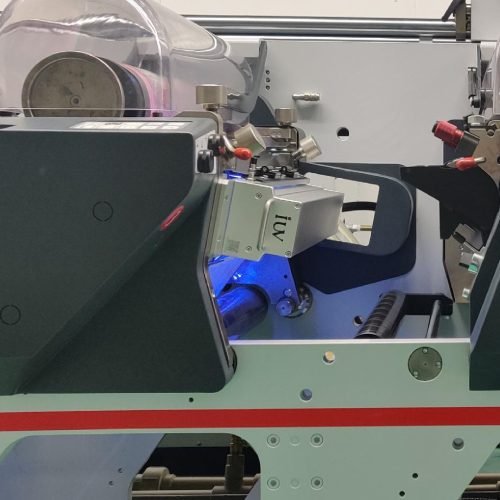
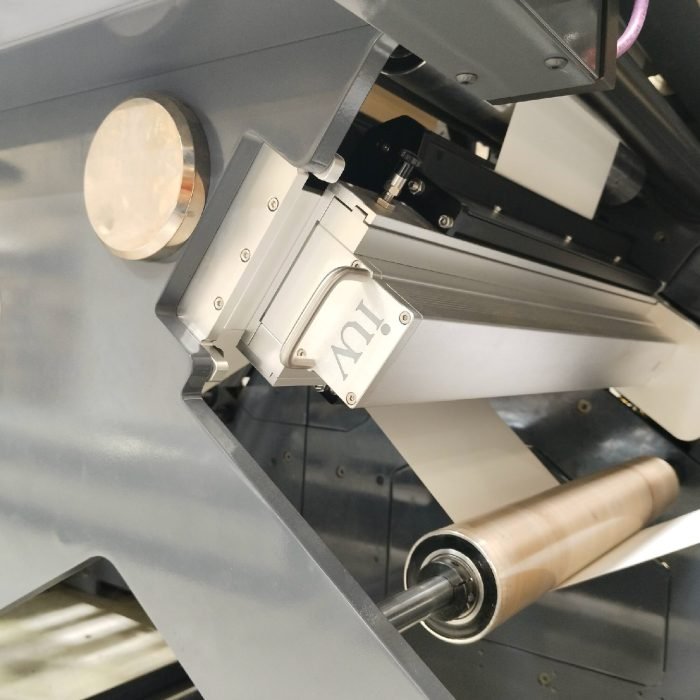
In the narrow web label industry, consistency determines the difference between a high-quality product and a costly rejection. Whether you run a high-speed flexo press or a precision offset line, achieving uniform UV curing across the entire web width is a technical necessity. When curing is uneven, printers face issues like ink picking, poor adhesion, color shifts, and even chemical migration.
Controlling UV curing uniformity requires a deep understanding of light geometry, ink chemistry, and hardware maintenance. This guide breaks down the variables that impact curing consistency and how to manage them for peak production performance.
The Critical Metrics: Irradiance and Dose
To control uniformity, you must first distinguish between two fundamental measurements: Peak Irradiance and Energy Density (Dose).
Peak Irradiance refers to the intensity of the UV light hitting the surface. It is measured in Watts per square centimeter ($W/cm^2$). High peak irradiance is necessary to initiate the polymerization process, especially in high-speed flexo printing where the ink film moves under the lamp in milliseconds.
Energy Density, or Dose, represents the total amount of UV energy the ink receives over time. It is measured in Joules per square centimeter ($J/cm^2$). Dose is influenced by both the lamp intensity and the press speed.
Uniformity means ensuring that every millimeter of the label—from the operator side to the gear side—receives the exact same Peak Irradiance and Dose.
Lamp Geometry and Reflector Maintenance
In traditional mercury arc UV systems, the reflector is the most influential component for uniformity. These systems rely on elliptical or parabolic reflectors to focus light onto a narrow focal point on the web.
Reflector Alignment
If the reflectors are warped or improperly seated, the focal point shifts. This creates “hot spots” and “cold spots” across the web. In narrow web applications, even a 2mm misalignment can lead to uncured ink at the edges of the label. Regular inspection of the reflector housing is mandatory.
Surface Degradation
Reflectors lose their reflectivity over time due to heat and ozone exposure. Dust and ink mist also settle on the surface, scattering the light rather than reflecting it. A dirty reflector can reduce UV output by 30% or more. This degradation is rarely uniform; it usually happens faster in the center of the lamp where heat is highest. Implementing a strict cleaning schedule using approved solvents is the first step toward curing stability.
Transitioning to LED-UV for Superior Uniformity
LED-UV technology has revolutionized narrow web printing by offering a much more stable light source than mercury lamps. However, LED systems come with their own set of uniformity challenges.
Diode Consistency
LED arrays consist of hundreds of individual diodes. High-quality LED curing systems use “binning” processes to ensure that every diode in the array has a nearly identical output. Cheaper LED systems may show “strips” of lower intensity if the diodes are not matched correctly.
Thermal Management
LED output is highly sensitive to temperature. If the water-cooling or air-cooling system fails to dissipate heat evenly across the lamp head, the diodes will age at different rates. Over-heated diodes lose intensity faster, leading to a drop-off in curing power in specific zones of the web. Monitoring the cooling system’s flow rate and temperature is vital for maintaining a flat curing profile.
Impact of Web Speed and Press Dynamics
Narrow web presses, particularly those used for labels, often fluctuate in speed during start-ups or roll changes.
Speed Compensation
Most modern UV systems utilize a “power-to-speed” follow-up. As the press slows down, the UV system dims to prevent overheating the substrate. However, this relationship is not always linear. At very low speeds, the “dwell time” under the lamp increases, which can change the cross-linking structure of the ink compared to high-speed runs.
Substrate Stability
In narrow web flexo, the substrate must remain perfectly flat as it passes under the UV station. If the web flutters or bows, the distance between the ink and the UV source changes. Because UV intensity follows the inverse square law, a small increase in distance results in a massive drop in irradiance. Using properly tensioned chill rollers or vacuum plates ensures the substrate stays within the “sweet spot” of the UV lamp’s focus.
Ink Chemistry and Oxygen Inhibition
Uniformity isn’t just about the light; it’s about how the ink responds to that light. Flexo inks are particularly susceptible to oxygen inhibition.
Oxygen in the air can penetrate the top layer of the ink film and terminate the free-radical polymerization process. This results in a “tacky” surface even if the bottom of the ink layer is fully cured. If the airflow around the UV station is turbulent—perhaps due to poorly positioned exhaust fans—it can strip away the “monomer vapor” layer that helps protect the curing process. This leads to inconsistent surface cure across the web.
Offset UV inks, which are more viscous and applied in thinner layers, require extremely high peak irradiance to overcome this inhibition. Ensuring that the lamp is positioned at the correct angle to the substrate helps maximize the “hit” of photons, minimizing the time oxygen has to interfere with the reaction.
Measuring and Validating Uniformity
You cannot control what you do not measure. Relying on a “thumb twist” test is insufficient for professional label production.
Radiometry
Portable radiometers are the gold standard for measuring uniformity. These devices are passed through the press at production speeds. By running the radiometer at the operator side, center, and gear side of the web, you can map the intensity profile of your lamps. If the readings vary by more than 10%, your system requires maintenance or recalibration.
UV-Sensitive Strips
For daily checks, UV-sensitive tapes or strips provide a visual color change based on the dose received. While less precise than digital radiometers, they are excellent for spotting immediate lamp failures or major reflector issues across the narrow web.
Real-time Monitoring
Advanced LED systems now include internal sensors that monitor the output of the diodes in real-time. These systems can alert the operator if a segment of the lamp falls below the required threshold, preventing thousands of meters of wasted substrate.
Practical Troubleshooting for Narrow Web Printers
If you detect curing inconsistency, follow this diagnostic path:
- Check the Distance: Ensure the lamp head is parallel to the substrate. Use a feeler gauge to verify the distance at both ends of the lamp.
- Inspect the Bulbs: For mercury systems, look for “bowing” or “blackening” at the ends of the quartz tube. For LED, check for any dark spots in the array.
- Clean the Quartz: Even a fingerprint on a quartz plate or bulb can block UV light and create a shadow on the web.
- Verify the Ink Weight: Inconsistent anilox roll wear or uneven doctor blade pressure can cause thicker ink deposits in certain areas. Thicker ink requires more energy to cure. If your ink film isn’t uniform, your cure won’t be either.
- Test the Cooling: Ensure that air filters are clean and water chillers are at the set point. Overheating is the primary cause of sudden UV output drops.
The Role of Shielding and Reflection
In narrow web presses, space is tight. Components like idler rollers and frames can sometimes reflect stray UV light back onto the web or, conversely, cast shadows. Ensure that the “curing zone” is free from any mechanical interference. Furthermore, ensure that the light shielding is designed to contain the UV energy without creating heat pockets that could distort thin film labels.
Strategy for Long-term Consistency
To maintain uniformity over years of production, move toward a predictive maintenance model. Do not wait for an ink failure to check your UV lamps.
Record the “baseline” output of new lamps or LEDs and track the decline over time. By knowing your “safety margin”—the difference between the energy required to cure the ink and the maximum output of the lamp—you can schedule replacements before the system reaches a critical failure point.
Consistency in narrow web label printing is a product of disciplined process control. By managing the geometry of the light, the stability of the press, and the precision of the chemistry, you ensure that every label meets the highest standards of durability and aesthetics. Uniformity is not just a setting on the press; it is an ongoing commitment to technical excellence.