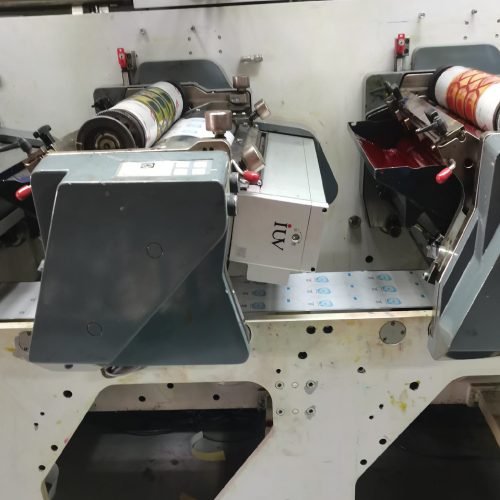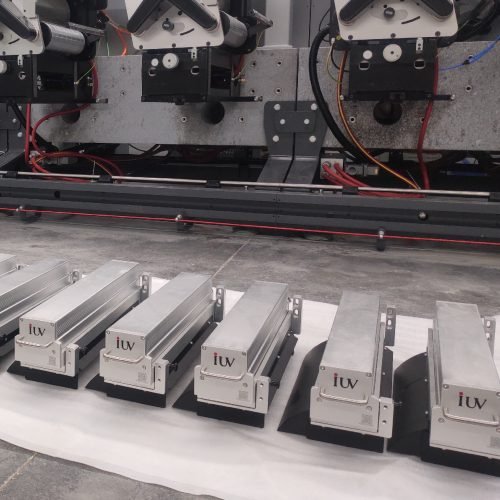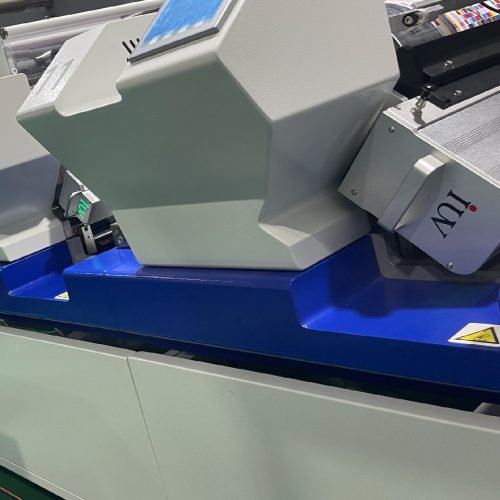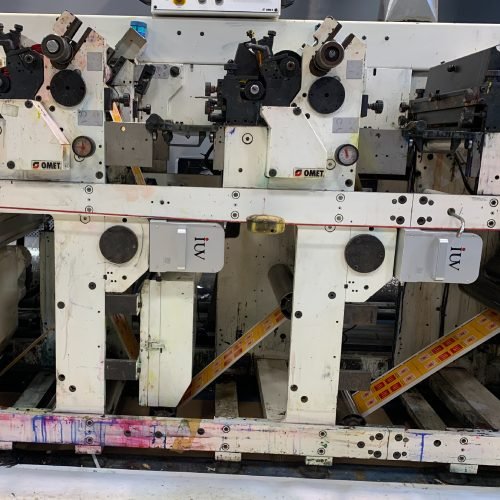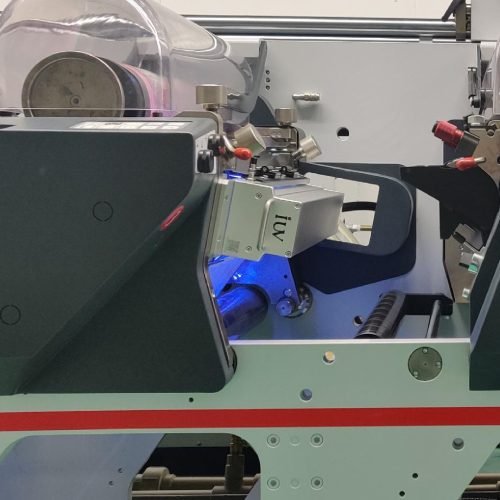
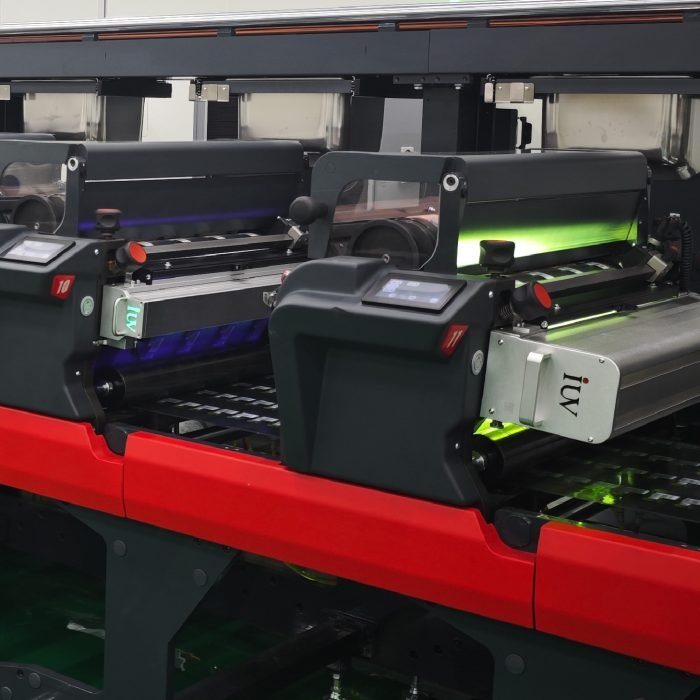
In narrow web printing, thermal behavior is not a side issue. It is a central process variable that directly affects print quality, registration stability, converting accuracy, and overall production efficiency. Whether the job runs on pressure-sensitive labels, unsupported films, coated paper, shrink materials, or multilayer constructions, the relationship between curing energy and substrate response must be controlled with precision. This is where UV LED curing systems have brought a major shift to modern flexographic and offset label production.
Compared with traditional mercury UV lamps, UV LED curing systems deliver a narrower spectral output and significantly lower thermal load. That makes them highly attractive for heat-sensitive substrates used in narrow web applications. However, reduced heat does not mean zero thermal impact. Substrate distortion can still occur if the curing process is not matched correctly to ink film thickness, web speed, substrate construction, cooling performance, and press configuration.
In label printing, especially under high-speed production conditions, even small thermal changes can lead to measurable movement in the web. Those changes may first appear as slight registration drift, unstable tension, edge wave, curl, or inconsistent die-cutting. If left unresolved, they reduce throughput, increase waste, and compromise final label quality. Understanding thermal dynamics in UV LED curing is therefore essential for maintaining dimensional control across the full print and converting process.
Why Thermal Control Matters in Narrow Web Printing
Narrow web presses operate within compact mechanical layouts. Multiple print stations, curing units, chill rolls, tension zones, and converting modules are arranged within a relatively short web path. This compact design improves productivity, but it also means the substrate has limited time to recover between thermal and mechanical events.
As the web moves through the press, it experiences a sequence of energy inputs and mechanical forces. Ink transfer, impression pressure, UV exposure, web tension, and roller contact all influence the substrate’s dimensional behavior. If thermal input becomes uneven or excessive, the substrate may expand, soften, relax, or distort in ways that disrupt the stability of the entire process.
In flexographic label printing, this becomes especially important when working with thin films, low-gauge liners, or high-value decorative labels. A material that changes shape by a very small amount can still cause visible print defects or downstream converting problems. That is why thermal control must be built into the curing strategy from the beginning.
How UV LED Curing Changes the Thermal Environment
The most obvious thermal advantage of UV LED curing is the reduction of infrared heat. Traditional UV systems emit a broad energy spectrum, much of which is not used efficiently for polymerization and instead becomes unwanted heat. UV LED systems concentrate their output within a narrow wavelength range, typically between 365 nm and 405 nm, depending on system design and ink chemistry.
This focused energy profile improves curing efficiency and reduces unnecessary thermal loading on the substrate. It also allows operators to work more confidently with sensitive materials that would otherwise distort under conventional UV conditions. For narrow web converters, this creates opportunities to improve print quality while expanding the range of printable substrates.
Still, UV LED systems are not thermally neutral. Heat is generated within the LED array itself and must be removed through proper cooling. Some of the emitted energy is absorbed by the ink and substrate, especially in dense solids, dark colors, opaque whites, and high-build coatings. If that energy is not controlled properly, localized heating can still affect substrate behavior.
Understanding Substrate Distortion in Label Production
Substrate distortion occurs when the material changes dimension or shape under thermal or mechanical stress. In narrow web production, this can happen in the machine direction, across the web width, or as a combination of both. The result may be visible immediately, or it may only become apparent later during lamination, die-cutting, slitting, or rewinding.
Common distortion symptoms include edge curl, tunnel distortion, web wander, wrinkling, unstable registration, poor die alignment, liner puckering, and inconsistent roll build. These issues are often blamed on tension or converting setup, but many originate much earlier in the curing zone.
Different substrate constructions react differently to thermal input. A thin BOPP face stock will not behave the same way as PET, PE, coated paper, shrink film, or a multilayer laminate. Pressure-sensitive materials introduce additional complexity because the face stock, adhesive layer, and release liner each respond differently to heat. This means distortion control is not only about the substrate surface. It is about the entire label construction.
Balancing Cure Performance and Dimensional Stability
One of the most important engineering challenges in UV LED printing is finding the balance between complete cure and dimensional control. If curing energy is too low, the ink may remain undercured, causing poor adhesion, low rub resistance, blocking, or downstream converting failures. If curing energy is too high, the substrate may remain flat at the print station but distort later due to accumulated thermal stress.
The correct process window depends on several interacting factors. These include the LED output level, lamp-to-substrate distance, web speed, ink chemistry, substrate type, and the number of curing events the web experiences before rewinding or finishing. In narrow web label printing, there is rarely a single universal setting that works for every job.
This is especially true in multi-color flexographic printing where several layers of ink are applied wet-on-wet and cured in sequence. The thermal and photochemical demand of each station must be considered in relation to the full print architecture. A curing setup that works for a simple paper label may be unsuitable for a shrink sleeve or a high-opacity filmic job.
Ink Film Thickness and Thermal Load Distribution
Ink laydown has a direct influence on thermal dynamics. In flexographic printing, the volume of ink transferred by the anilox roll determines not only print density and color strength, but also how much energy the curing system must deliver. Heavier ink films typically require more UV dose to achieve full polymerization, and they also tend to retain more localized heat.
This becomes particularly relevant with opaque whites, dense blacks, metallic-supporting layers, tactile coatings, and overprint varnishes. These applications often look visually dry at the surface while still carrying thermal load or incomplete internal cure beneath the top layer. If the substrate is already close to its distortion threshold, the added energy required for these structures can create stability issues.
To control this, converters must align anilox volume, ink rheology, and curing strategy rather than treating them as separate process decisions. Stable thermal behavior depends on efficient energy use, not simply maximum output.
The Role of Cooling Systems in LED UV Stability
The cooling system is one of the most important elements in any UV LED curing installation. While the substrate experiences less heat than it would under conventional UV, the LED head itself must still manage significant internal thermal energy. If that heat is not removed efficiently, diode junction temperature rises, optical performance may drift, and the overall curing profile becomes less stable.
Cooling performance directly affects both curing consistency and thermal control at the web. A system with poor coolant flow, fouled manifolds, insufficient heat exchange, or unstable fluid temperature may still appear operational, but its real-world process behavior will be compromised.
In narrow web production, this can translate into gradual output loss, uneven cross-web cure, inconsistent gloss, or increased substrate movement during longer runs. Maintaining stable coolant temperature and clean internal flow paths is therefore essential not only for lamp life, but also for substrate distortion control.
Lamp Position, Mechanical Geometry, and Web Exposure
The physical position of the UV LED head has a major influence on both cure quality and thermal distribution. Lamp-to-web distance affects irradiance intensity, exposure uniformity, and the concentration of thermal energy delivered to the ink and substrate. If the curing head is positioned too far away, output efficiency declines and operators may compensate by increasing power. If it is too close, local heating can rise and distortion risk increases.
Uniformity across the width is equally important. If the head sits closer on one side than the other, one edge of the web may receive more energy and develop greater dimensional movement. This can create skew, curl, or lane-to-lane instability that becomes difficult to correct later in the process.
Mechanical rigidity also matters. If the mounting structure flexes, vibrates, or shifts under running conditions, the curing geometry changes dynamically. In narrow web printing, even small movement can affect thermal repeatability. Proper mounting design and alignment are therefore essential parts of any stable LED UV curing setup.
Web Speed, Dwell Time, and Thermal Accumulation
Thermal behavior in UV LED curing cannot be separated from web speed. As line speed changes, the dwell time of the substrate under the curing zone changes as well. A system that is thermally stable at one production speed may behave differently during acceleration, slowdown, or stop-start operation.
In many label jobs, the highest distortion risk does not occur during steady-state running. It appears during ramp-down, setup, splice recovery, or inspection pauses where the web sees more concentrated exposure or less efficient heat recovery. If the curing logic does not respond dynamically to actual web conditions, localized thermal overload can occur even when average production settings appear safe.
This is why high-speed narrow web lines benefit from curing strategies that are synchronized to real process behavior rather than fixed output assumptions. Thermal stability improves when UV dose remains proportional to what the web actually needs at every operating state.
Chill Rolls and Thermal Recovery Between Stations
Chill rolls and controlled thermal recovery zones play an important role in substrate stability. Their function is not only to cool the material, but also to restore dimensional balance before the web enters the next critical process step. In narrow web printing, where stations are closely spaced, this recovery time can make a significant difference.
A properly managed chill roll can reduce residual heat, stabilize the web surface, and improve registration consistency. However, chill roll strategy must be tuned carefully. Overcooling can create condensation risk or substrate brittleness in certain environments, while insufficient cooling allows thermal accumulation to continue through the press.
Roll wrap angle, contact time, roll temperature, and station spacing all influence how effectively the web recovers after cure. Good thermal engineering uses these variables intentionally rather than treating them as passive machine features.
Thermal Stability and Downstream Converting Performance
One of the strongest advantages of well-controlled UV LED curing is the improvement it brings to downstream converting. A dimensionally stable web behaves more predictably during die-cutting, stripping, slitting, laminating, and rewinding. This directly improves final label quality and reduces waste.
When substrate distortion is poorly controlled, problems often appear after printing is complete. Labels may not die-cut cleanly, matrix stripping may become erratic, roll edges may telescope, or the finished product may show curl during application. These issues can be expensive because they often emerge late in the manufacturing cycle when material and labor value are already high.
A thermally stable curing process reduces these risks by preserving the dimensional integrity of the substrate from the print station to the finished roll. This is one of the reasons UV LED curing is increasingly favored in high-value label production where print quality and converting precision must work together.
Building a Stable UV LED Process Window
Successful thermal control does not come from a single hardware feature. It comes from building a stable process window. That process window should include the correct LED output range, matched ink chemistry, suitable anilox selection, consistent cooling performance, stable web tension, correct lamp geometry, and realistic speed-to-dose coordination.
When these variables are aligned, the press becomes easier to run and more predictable across different label constructions. Operators spend less time correcting tension, chasing registration, or compensating for distortion symptoms that actually began at the curing stage.
For narrow web converters, this is where the real production value of UV LED lies. It is not only about lower energy consumption or reduced maintenance. It is about creating a controlled thermal environment that supports both print performance and converting stability under real commercial conditions.
Conclusion
Thermal dynamics and substrate distortion control are critical to achieving consistent results with UV LED curing systems on narrow web presses. Although LED technology significantly reduces unnecessary heat compared with conventional UV, successful production still depends on careful engineering of the full process. Cure energy, substrate structure, cooling efficiency, web speed, lamp geometry, ink film thickness, and tension behavior must all be managed together.
When thermal behavior is controlled properly, UV LED curing supports sharper registration, better adhesion, flatter webs, cleaner converting, and more reliable overall productivity. In label printing, flexographic production, narrow web offset, and hybrid UV workflows, that level of control is essential for maintaining quality and efficiency across a wide range of demanding applications.