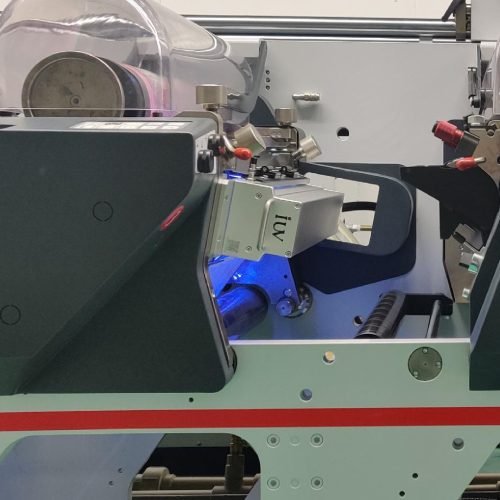
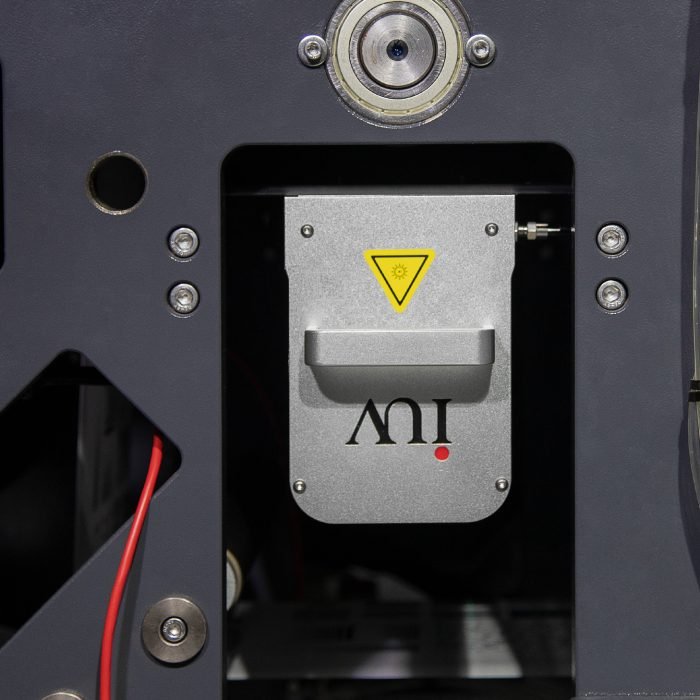
Web temperature management is one of the most critical variables in high-speed flexographic printing. As press speeds increase and curing demands become more aggressive, uncontrolled thermal buildup can quickly compromise print quality, substrate stability, and overall production efficiency. In narrow web label printing, where unsupported films, pressure-sensitive materials, and thin facestocks are common, even minor temperature fluctuations can cause distortion, tension instability, and curing inconsistency.
Smart UV control has become an essential tool for solving these challenges. By combining precise irradiance regulation, thermal feedback monitoring, and dynamic curing adjustment, modern UV curing systems allow printers to maintain optimal web temperature without sacrificing curing performance. In flexographic, offset, and narrow web production environments, proper temperature management is now directly tied to process stability and print quality.
Why Web Temperature Matters in High-Speed Flexographic Printing
During UV curing, not all emitted energy contributes to polymerization. A portion converts into thermal load on the substrate. As web speed increases, printers often raise lamp power or curing intensity to maintain full cure. This can create excessive heat input, especially when printing dense graphics, heavy coatings, or multiple wet-on-wet colors.
In flexible substrates such as PET, BOPP, PE, and thin label laminates, elevated web temperature can lead to dimensional instability. The substrate may stretch, shrink, wrinkle, or deform as it passes through the press. Once distortion occurs, print registration suffers and downstream converting performance declines.
Controlling web temperature is therefore not simply a comfort measure for heat-sensitive substrates. It is a process requirement for maintaining registration, curing quality, and mechanical stability throughout the press line.
Identifying the Most Common Temperature-Related Problems
Web temperature issues often appear indirectly through print defects rather than obvious heat readings. One common symptom is progressive register drift during long press runs. As the substrate expands from heat exposure, print-to-print alignment changes across successive stations.
Another frequent issue is edge curl or web waviness after curing. This occurs when heat distribution is uneven across the web width, causing differential expansion and contraction. In unsupported films, excessive heat can also reduce tensile stability, leading to flutter and tension control problems.
Operators may also observe adhesive ooze in pressure-sensitive constructions, liner distortion, or inconsistent die-cutting after printing. These symptoms often originate from excessive curing heat rather than mechanical press faults.
Understanding the Role of Smart UV Control
Smart UV control refers to curing systems capable of dynamically adjusting output based on real-time production conditions. Instead of operating at fixed lamp intensity, the system modulates irradiance according to speed, substrate sensitivity, coverage density, and thermal feedback.
This allows the curing unit to deliver only the energy required for complete polymerization while minimizing unnecessary heat input. In LED UV systems, this capability is especially effective because LED output can be adjusted instantly without warm-up delay.
By continuously matching curing energy to process demand, smart UV control reduces thermal overload while preserving curing consistency at high speed.
Optimize Irradiance Based on Actual Cure Demand
One of the most common causes of excessive web temperature is over-curing. Many operators run UV systems at unnecessarily high intensity to create a safety margin for cure performance. While this approach may prevent under-cure, it introduces excess thermal energy into the substrate.
Smart UV control solves this by allowing irradiance to be matched precisely to ink chemistry, coverage level, and press speed. Low-coverage jobs require less energy than dense solids or high-build coatings. By reducing output when full power is not needed, web temperature can be significantly lowered.
In narrow web flexographic printing, this optimization often reduces substrate heat without sacrificing throughput.
Balance Peak Irradiance and Dose for Better Thermal Management
Web temperature is influenced not only by total UV dose but also by how energy is delivered. High peak irradiance over a short exposure period may generate less total substrate heating than lower-intensity exposure over extended dwell time.
Smart UV systems enable operators to balance irradiance and dose more precisely. By delivering concentrated curing energy efficiently at the correct wavelength, polymerization occurs rapidly while minimizing heat transfer into the substrate.
This approach is particularly effective in LED UV curing, where narrow spectral output improves energy efficiency compared with conventional mercury lamps.
Use Zone Control Across the Web Width
Uneven temperature across the web is a common problem in wide narrow-web applications and multi-lane label production. Edge overheating or centerline temperature variation can cause curl, distortion, and curing inconsistency.
Advanced smart UV systems incorporate zone-based output control across the curing head width. This allows different sections of the lamp to operate at varying intensities based on print coverage or substrate behavior.
Zone control is valuable when printing mixed graphics across the web or when edge conditions differ from center zones. By equalizing heat distribution, operators can maintain better dimensional stability and reduce distortion.
Integrate Temperature Feedback Sensors
Real-time thermal monitoring is one of the most powerful tools in smart UV control. Infrared temperature sensors or thermal cameras positioned along the web path provide continuous substrate temperature data.
When integrated into the curing control system, this feedback allows automatic adjustment of lamp output if web temperature exceeds target thresholds. The system can reduce irradiance temporarily or redistribute energy to prevent overheating.
This closed-loop control is especially useful in long production runs where substrate temperature may gradually rise over time due to cumulative thermal loading.
Coordinate Cooling and UV Control Together
UV curing optimization alone cannot solve all temperature issues. Effective thermal management also requires coordinated cooling throughout the press.
Chill rollers, web cooling drums, and airflow systems should work together with UV control to remove residual heat after curing. Smart UV systems can be programmed to account for downstream cooling efficiency when determining optimal output.
If cooling capacity is limited, curing intensity may need to be adjusted accordingly. In well-designed narrow web systems, curing and cooling are treated as a single integrated thermal management process rather than separate functions.
Adapt Settings for Different Substrate Types
Not all substrates tolerate heat equally. Unsupported PET films behave differently from pressure-sensitive paper stocks, and shrink sleeves require more aggressive thermal control than standard label constructions.
Smart UV control allows recipe-based parameter storage for different substrate families. Operators can predefine curing limits, irradiance curves, and temperature thresholds for each material type.
This reduces setup time while improving repeatability between jobs. It also minimizes operator error when switching between heat-sensitive and heat-resistant substrates.
Monitor Environmental and Production Variables
Ambient conditions affect web temperature more than many operators realize. High room temperature, poor ventilation, and nearby equipment heat sources can all reduce cooling efficiency and increase substrate temperature.
Likewise, production factors such as increased press speed, higher coverage graphics, or additional coating stations can raise thermal load unexpectedly. Smart UV control systems should be configured to account for these variables rather than relying on static curing presets.
Continuous monitoring and adaptive control help maintain stable performance even as production conditions change.
Prevent Long-Term Substrate Deformation and Quality Loss
Repeated exposure to elevated temperature may not always create immediate defects, but it can cause long-term substrate damage. Films may lose dimensional stability, adhesives may degrade, and label constructions may become more difficult to convert downstream.
By maintaining lower and more stable web temperatures, smart UV control improves not only immediate print quality but also downstream finishing performance, laminating reliability, and end-use product stability.
This is especially important in premium label applications where converting precision and finished appearance are critical.
Conclusion
Solving web temperature issues in high-speed flexo printing requires more than reducing lamp power. It demands intelligent control of curing energy, real-time thermal monitoring, and coordinated cooling strategies across the entire press line.
Smart UV control provides the precision needed to match curing performance with actual production requirements while minimizing unnecessary heat input. In label printing, flexographic production, offset applications, and narrow web converting, this approach improves substrate stability, enhances print consistency, and protects overall production efficiency.
As press speeds continue to increase and substrates become thinner and more heat-sensitive, advanced thermal management through smart UV control will remain essential for stable, high-quality UV printing.