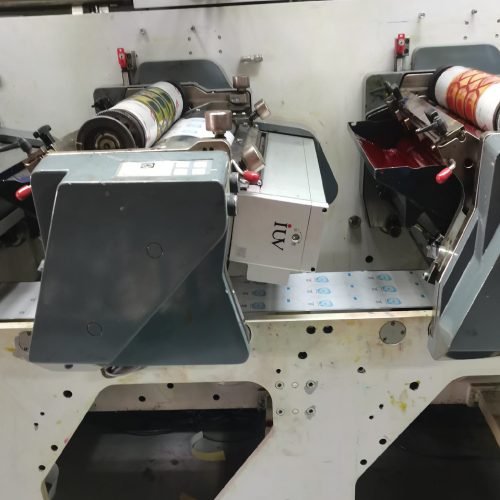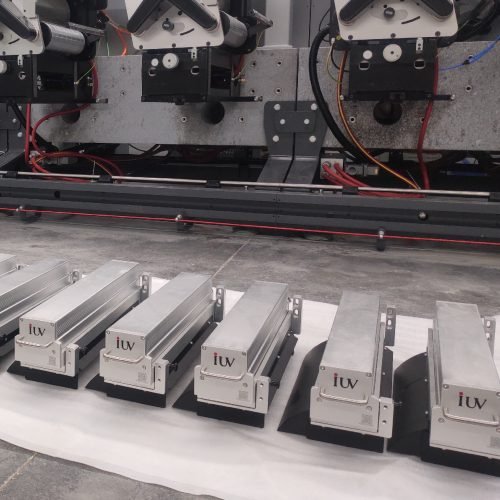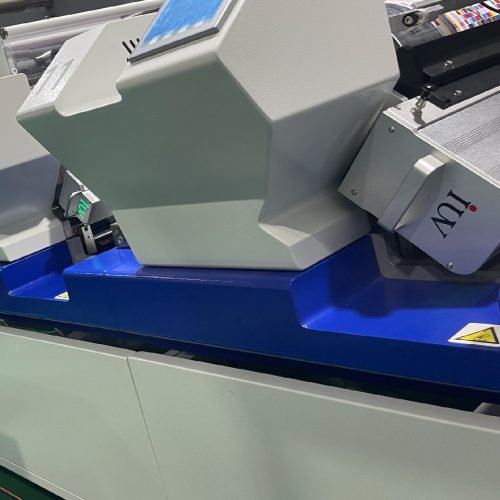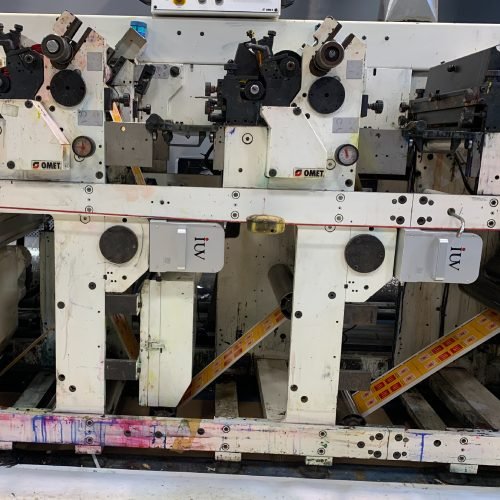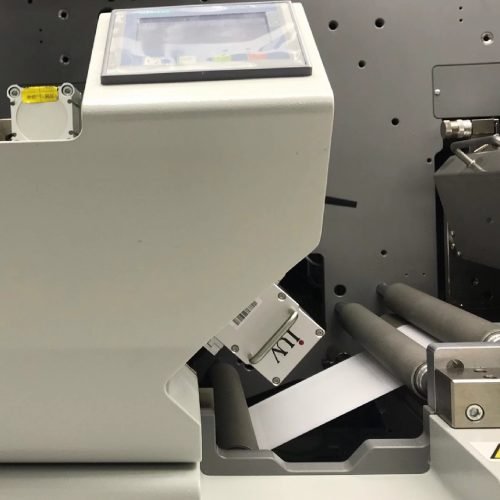
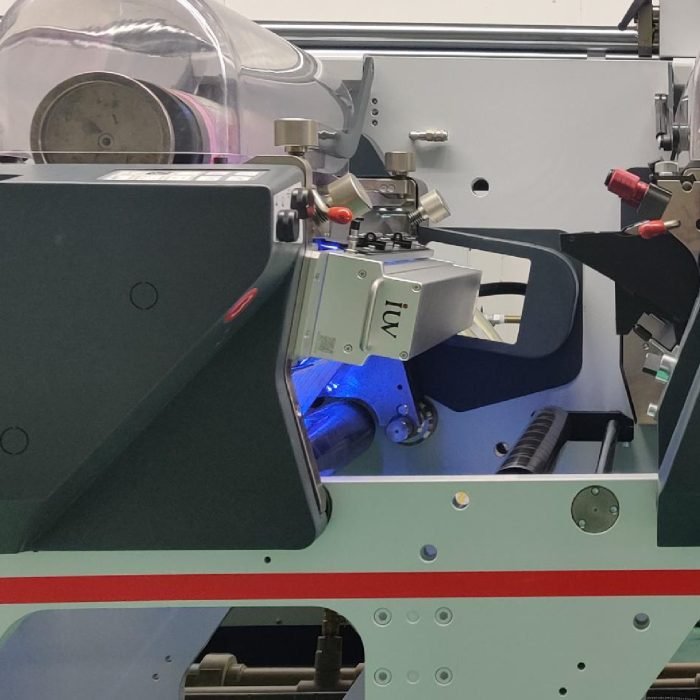
In narrow web label production, curing efficiency is directly connected to print stability, ink adhesion performance, substrate handling, and overall production speed. In many existing flexographic printing facilities, older mercury lamp systems continue to operate despite increasing pressure for higher productivity, lower energy consumption, and better process consistency. As a result, retrofit LED conversion has become a practical engineering solution rather than a complete equipment replacement strategy. The discussion around Curing Efficiency Improvement Using Retrofit UV LED System for Flexographic Press Label Applications is therefore centered on process optimization inside real industrial production environments.
In flexographic label printing, curing performance is heavily influenced by substrate structure, ink formulation, press speed, and UV dose stability. Traditional mercury UV systems were historically preferred because their broadband spectral output provided relatively tolerant curing conditions across different UV ink chemistries. However, this tolerance came at the cost of high thermal output, unstable energy utilization, and increasing maintenance requirements.
The move toward Curing Efficiency Improvement Using Retrofit UV LED System for Flexographic Press Label Applications changes the curing process from a thermally assisted system into a wavelength-controlled photochemical process. This transition improves efficiency, but also exposes weaknesses in ink formulation, cooling stability, and process synchronization.
UV wavelength optimization and photoinitiator response
The primary technical difference between mercury systems and retrofit LED UV systems lies in spectral distribution. Mercury lamps emit broadband UV radiation together with visible light and infrared energy. Only part of this spectrum contributes directly to polymerization.
LED UV curing systems concentrate energy within narrow wavelength ranges, typically around 385 nm or 395 nm. In Curing Efficiency Improvement Using Retrofit UV LED System for Flexographic Press Label Applications, this spectral concentration significantly improves photon utilization efficiency when the UV ink chemistry is correctly matched to the LED wavelength.
In practical label printing environments, the curing result depends on the interaction between photoinitiator absorption behavior and UV dose delivery. If the photoinitiator package is optimized for mercury lamps rather than LED systems, operators may observe incomplete polymerization despite apparently sufficient irradiance.
This issue becomes particularly visible in opaque whites, matte varnishes, and high-density flexographic coatings where UV penetration depth is limited. Surface curing may appear acceptable while internal crosslinking remains incomplete, resulting in reduced UV ink adhesion or poor scratch resistance during converting operations.
UV dose behavior at high flexographic press speeds
In narrow web label printing, exposure time is extremely short because press speeds frequently exceed 150 m/min. Under these conditions, curing efficiency depends less on raw power output and more on how effectively UV energy is converted into chemical polymerization.
In Curing Efficiency Improvement Using Retrofit UV LED System for Flexographic Press Label Applications, LED systems improve curing consistency by providing more stable UV dose output during speed fluctuations and job transitions.
Unlike mercury systems, which require warm-up stabilization, retrofit LED UV systems achieve instant operational stability. This is especially important in modern label production where short runs and frequent SKU changes dominate daily operation.
However, increasing irradiance alone does not guarantee improved curing efficiency. Excessive surface polymerization can create a hardened outer layer that limits UV penetration into deeper ink structures. In practical troubleshooting, this often appears as acceptable surface cure combined with downstream adhesion failure during lamination or die cutting.
Thermal reduction and substrate stability
One of the largest operational advantages in Curing Efficiency Improvement Using Retrofit UV LED System for Flexographic Press Label Applications is reduced thermal load on the substrate.
Mercury UV systems generate significant infrared radiation, increasing web temperature and affecting substrate stability. In synthetic films such as BOPP, PET, and shrink sleeve materials, excessive heat can cause web elongation, register instability, and dimensional distortion.
Retrofit LED UV systems dramatically reduce infrared emission, improving tension stability and reducing thermal stress during high-speed flexographic printing. This is particularly important in narrow web production where even small web movement variations can affect print registration quality.
At the same time, LED systems introduce their own thermal engineering challenges. Semiconductor junction temperature directly affects wavelength stability. If cooling systems are poorly designed or airflow becomes restricted, wavelength drift occurs, reducing photoinitiator activation efficiency and destabilizing UV dose consistency.
This means curing efficiency depends not only on optical output, but also on thermal management architecture inside the retrofit system.
Oxygen inhibition and surface cure performance
Oxygen inhibition remains a major limitation in UV curing technology, especially in thin ink films typical of label printing applications. Oxygen molecules interfere with free radical polymerization at the ink surface, reducing curing efficiency and creating tackiness or poor chemical resistance.
In mercury systems, high thermal energy sometimes masks partial curing deficiencies. After retrofit conversion, LED UV systems expose the true efficiency of the photochemical process because less thermal compensation occurs.
In Curing Efficiency Improvement Using Retrofit UV LED System for Flexographic Press Label Applications, operators often mistakenly interpret oxygen inhibition as insufficient LED power. In reality, the issue is frequently related to photoinitiator mismatch, excessive ink thickness, or inadequate UV wavelength compatibility.
Proper optimization requires balancing irradiance, wavelength selection, and UV ink chemistry rather than simply increasing energy output.
Material compatibility and UV ink adhesion
Label printing environments process a wide range of materials including coated papers, PE films, PET substrates, metallized labels, and shrink sleeve materials. Each substrate reacts differently to UV exposure and polymerization behavior.
In mercury systems, elevated substrate temperature sometimes improves apparent adhesion through slight surface softening. Retrofit LED systems reduce this thermal influence, meaning UV ink adhesion becomes more dependent on true polymer network formation.
In Curing Efficiency Improvement Using Retrofit UV LED System for Flexographic Press Label Applications, poor adhesion is often linked to insufficient crosslink density caused by incomplete bulk curing rather than low surface cure.
This distinction is critical in troubleshooting because increasing UV intensity may improve surface hardness without improving actual adhesion performance. Correct optimization requires simultaneous control of UV dose, wavelength distribution, substrate surface energy, and ink reactivity.
Operational efficiency and long-term production stability
Beyond immediate curing performance, retrofit LED systems significantly affect long-term operational behavior in flexographic printing environments.
Mercury lamps gradually lose spectral efficiency over time due to reflector degradation and bulb aging. Operators typically compensate by increasing lamp power, which raises energy consumption and thermal load.
In contrast, retrofit LED UV systems maintain more stable output characteristics across longer operational cycles. In Curing Efficiency Improvement Using Retrofit UV LED System for Flexographic Press Label Applications, this stability reduces production variability, minimizes setup waste, and improves repeatability between jobs.
Maintenance downtime is also reduced because there are no mercury bulbs requiring periodic replacement. In continuous label production, this operational stability contributes directly to higher production efficiency and more predictable curing performance.